锔 (jū) means "To mend with staples (pottery/metalware)" in Chinese. It has 12 strokes with the radical 钅.
Rated 4.2/5 in difficulty (advanced).
Appears in 3+ common words including 锔碗 (jū wǎn), 锔子 (jū zi), 锔锅 (jū guō).
Due to its 12 strokes, Hanzi Writer's error detection shows 锔 requires focused practice — most learners need 10+ attempts for consistent accuracy.
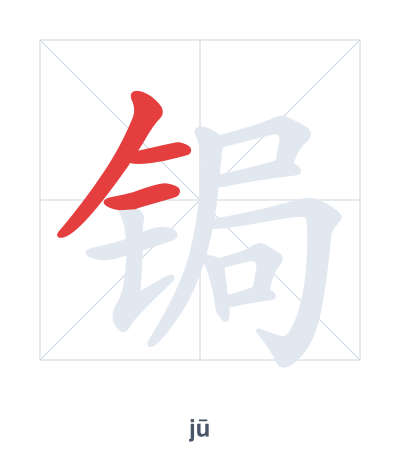
Open Hanzi Writer to see the animated stroke order and practice writing 锔 with real-time feedback.
The character 锔 (jū) is written with 12 strokes. Follow the standard Chinese stroke order: top to bottom, left to right, outside before inside. The radical 钅 is one of its key components.
Practice the correct stroke order with the Hanzi Writer app to see animated stroke-by-stroke guidance with real-time feedback.
锔 means To mend with staples (pottery/metalware).
锔 is a phono-semantic compound. The left radical 钅 (gold/metal) indicates the tool is made of metal, while the right side 居 (jū, meaning 'to reside') supplies the pronunciation. Together, they depict a metal staple used to repair cracks in pottery or metalware.
💡 Memory Tip: Picture a metal staple (钅) shaped like a little house (居) clamping a broken pot together.
爷爷以前学过锔碗。
yé yé yǐ qián xué guò jū wǎn
Grandpa used to learn how to mend bowls with staples.
他在裂缝处钉了几个锔子。
tā zài liè fèng chù dīng le jǐ gè jū zi
He drove a few metal staples into the crack.
老师傅正在街头锔锅。
lǎo shī fù zhèng zài jiē tóu jū guō
The old master is mending a pot on the street.
Open Hanzi Writer to see the animated stroke order and practice writing 锔 with real-time feedback.
✨ Animated stroke order · Handwriting recognition · HSK-graded practice · Free to use
锔 is composed of the radical 钅 (gold/metal) on the left, which hints that the action involves metal, and the phonetic component 居 (jū) on the right, which gives the sound. The literal meaning is to mend broken pottery or metalware by using metal staples, so the metal radical directly reflects the material used for repair.