韭 (jiǔ) means "leek; Chinese chives" in Chinese. It has 9 strokes with the radical 韭.
Rated 3.3/5 in difficulty (challenging).
Appears in 3+ common words including 韭菜 (jiǔ cài), 韭菜花 (jiǔ cài huā), 韭菜饼 (jiǔ cài bǐng).
Due to its 9 strokes, Hanzi Writer's error detection shows 韭 requires focused practice — most learners need 10+ attempts for consistent accuracy.
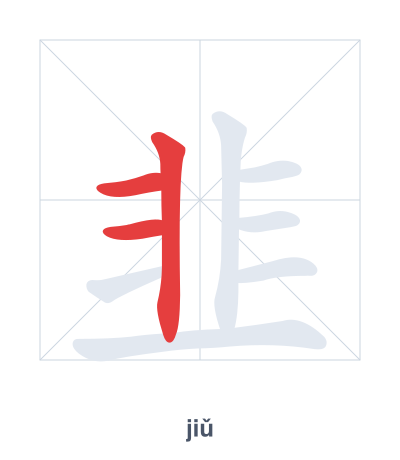
Open Hanzi Writer to see the animated stroke order and practice writing 韭 with real-time feedback.
The character 韭 (jiǔ) is written with 9 strokes. Follow the standard Chinese stroke order: top to bottom, left to right, outside before inside. The radical 韭 is one of its key components.
Practice the correct stroke order with the Hanzi Writer app to see animated stroke-by-stroke guidance with real-time feedback.
韭 means leek; Chinese chives.
| Character | 韭 |
| Pinyin | jiǔ (jiu) |
| Meaning | leek; Chinese chives |
| Strokes | 9 |
| Radical | 韭 |
| Difficulty | 3.3/5 |
韭 is a pictograph of a leek plant. The ancient oracle bone and bronze forms show a tuft of broad leaves emerging from the ground, with a horizontal line representing the soil. The modern character retains this structure: three vertical strokes for leaves above a single horizontal line for the earth, with an additional stroke at the bottom hinting at the roots.
💡 Memory Tip: Imagine nine (9) long chive stalks growing in a neat row, with the ground line below them — 韭 looks exactly like a bundle of nine leeks ready to harvest.
我喜欢吃韭菜。
wǒ xǐ huān chī jiǔ cài
I like eating chives.
韭菜花很香。
jiǔ cài huā hěn xiāng
Chive flowers are very fragrant.
妈妈做了韭菜饼。
mā mā zuò le jiǔ cài bǐng
Mom made chive pancakes.
Open Hanzi Writer to see the animated stroke order and practice writing 韭 with real-time feedback.
✨ Animated stroke order · Handwriting recognition · HSK-graded practice · Free to use
The character 韭 is a pictograph that looks like a plant with long leaves growing from the ground. Its shape directly represents Chinese chives, with the vertical strokes symbolizing the stalks and the horizontal strokes representing the leaves. This character is also its own radical, meaning it cannot be broken into smaller meaningful parts.