妗 (jìn) means "Aunt (wife of mother's brother)" in Chinese. It has 7 strokes with the radical 女.
Rated 3.5/5 in difficulty (challenging).
Appears in 3+ common words including 妗子 (jìn zi), 大妗 (dà jìn), 小妗 (xiǎo jìn).
Due to its 7 strokes, Hanzi Writer's error detection shows 妗 requires focused practice — most learners need 10+ attempts for consistent accuracy.
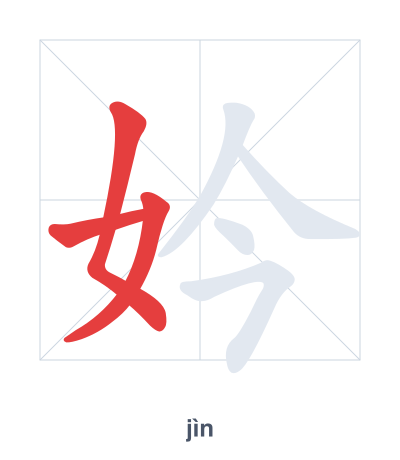
Open Hanzi Writer to see the animated stroke order and practice writing 妗 with real-time feedback.
The character 妗 (jìn) is written with 7 strokes. Follow the standard Chinese stroke order: top to bottom, left to right, outside before inside. The radical 女 is one of its key components.
Practice the correct stroke order with the Hanzi Writer app to see animated stroke-by-stroke guidance with real-time feedback.
妗 means Aunt (wife of mother's brother).
妗 is a compound character with the radical 女 (woman) indicating a female family member, and 今 (jīn, 'now') as a phonetic component hinting at the pronunciation. The character specifically denotes the wife of one's mother's brother, combining the idea of 'woman' with the sound 今.
💡 Memory Tip: Imagine your aunt (wife of mother's brother) is so modern she always says '今 (now)'—she's the 'now woman' (女+今) in the family.
妗子在做饭。
jìn zi zài zuò fàn
Aunt is cooking.
大妗今天过生日。
dà jìn jīn tiān guò shēng rì
Eldest aunt is celebrating her birthday today.
小妗送我一个礼物。
xiǎo jìn sòng wǒ yí gè lǐ wù
My young aunt gave me a gift.
Open Hanzi Writer to see the animated stroke order and practice writing 妗 with real-time feedback.
✨ Animated stroke order · Handwriting recognition · HSK-graded practice · Free to use
The character 妗 is made of the radical 女 (woman) on the left and the phonetic component 今 (jīn) on the right. The radical 女 indicates that the meaning involves a female person, and 今 provides a clue to the pronunciation. Together, they form the word for 'aunt' (specifically the wife of one's mother's brother).