槿 (jǐn) means "Hibiscus" in Chinese. It has 15 strokes with the radical 木.
Rated 4.2/5 in difficulty (advanced).
Appears in 3+ common words including 木槿 (mù jǐn), 槿花 (jǐn huā), 槿篱 (jǐn lí).
Due to its 15 strokes, Hanzi Writer's error detection shows 槿 requires focused practice — most learners need 10+ attempts for consistent accuracy.
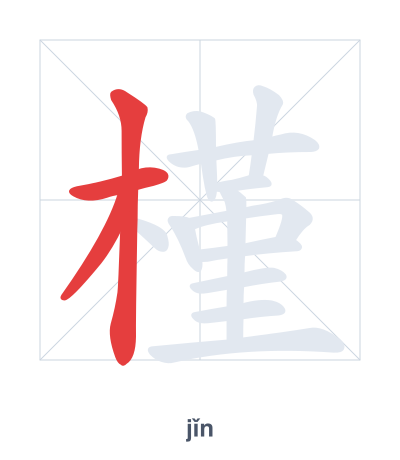
Open Hanzi Writer to see the animated stroke order and practice writing 槿 with real-time feedback.
The character 槿 (jǐn) is written with 15 strokes. Follow the standard Chinese stroke order: top to bottom, left to right, outside before inside. The radical 木 is one of its key components.
Practice the correct stroke order with the Hanzi Writer app to see animated stroke-by-stroke guidance with real-time feedback.
槿 means Hibiscus.
槿 is a phono-semantic compound combining the radical 木 (wood/tree) indicating the plant category, and 堇 (jǐn), which provides the pronunciation and originally depicted a person with bound arms, but here functions as a phonetic component. The character refers to the hibiscus, a flowering shrub or small tree.
💡 Memory Tip: Picture a wooden fence (木) with a brilliant hibiscus flower (堇) blooming against it, its five petals forming a star-like shape.
院子里种了木槿。
yuàn zi lǐ zhǒng le mù jǐn
Hibiscus is planted in the yard.
槿花朝开暮落。
jǐn huā cháo kāi mù luò
Hibiscus flowers bloom in the morning and wither in the evening.
院子围着槿篱。
yuàn zi wéi zhe jǐn lí
The yard is surrounded by a hibiscus hedge.
Open Hanzi Writer to see the animated stroke order and practice writing 槿 with real-time feedback.
✨ Animated stroke order · Handwriting recognition · HSK-graded practice · Free to use
槿 is composed of the radical 木 (tree/wood) on the left and the phonetic component 堇 (jǐn) on the right. The radical indicates the character relates to plants or wood, while 堇 provides the sound. Together they form a character meaning 'hibiscus,' a type of flowering shrub.