锪 (huō) means "to countersink; to counterbore" in Chinese. It has 13 strokes with the radical 钅.
Rated 4.2/5 in difficulty (advanced).
Appears in 3+ common words including 锪孔 (huō kǒng), 锪钻 (huō zuān), 锪平 (huō píng).
Due to its 13 strokes, Hanzi Writer's error detection shows 锪 requires focused practice — most learners need 10+ attempts for consistent accuracy.
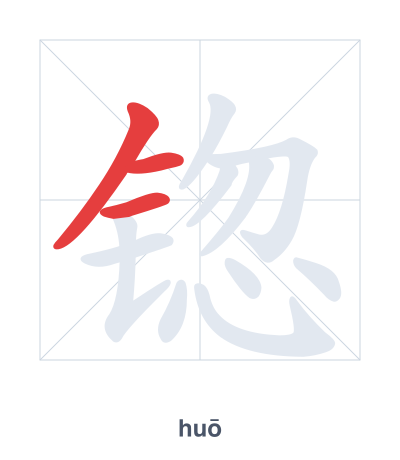
Open Hanzi Writer to see the animated stroke order and practice writing 锪 with real-time feedback.
The character 锪 (huō) is written with 13 strokes. Follow the standard Chinese stroke order: top to bottom, left to right, outside before inside. The radical 钅 is one of its key components.
Practice the correct stroke order with the Hanzi Writer app to see animated stroke-by-stroke guidance with real-time feedback.
锪 means to countersink; to counterbore.
锪 is a phono-semantic compound: the radical 钅 (metal) indicates a tool or metalworking, while 忽 (hū) provides the pronunciation and hints at the sudden, forceful action of drilling or countersinking.
💡 Memory Tip: Imagine a metal drill (钅) that suddenly (忽) bores a conical hole into a heart (心), countersinking a screw.
工人在锪孔。
gōng rén zài huō kǒng
The worker is countersinking a hole.
这是一个锪钻。
zhè shì yí gè huō zuān
This is a countersink drill.
把表面锪平。
bǎ biǎo miàn huō píng
Countersink the surface.
Open Hanzi Writer to see the animated stroke order and practice writing 锪 with real-time feedback.
✨ Animated stroke order · Handwriting recognition · HSK-graded practice · Free to use
锪 is made of the radical 钅 (metal) on the left and 忽 (hū, sudden) on the right. The metal radical shows it is related to metalworking tools, while 忽 provides the sound. Together, they describe a metal process that suddenly cuts or levels a hole.