桓 (huán) means "Pillar / Large tree / Valiant" in Chinese. It has 10 strokes with the radical 木.
Rated 4.2/5 in difficulty (advanced).
Appears in 3+ common words including 齐桓公 (qí huán gōng), 桓桓 (huán huán), 桓表 (huán biǎo).
Due to its 10 strokes, Hanzi Writer's error detection shows 桓 requires focused practice — most learners need 10+ attempts for consistent accuracy.
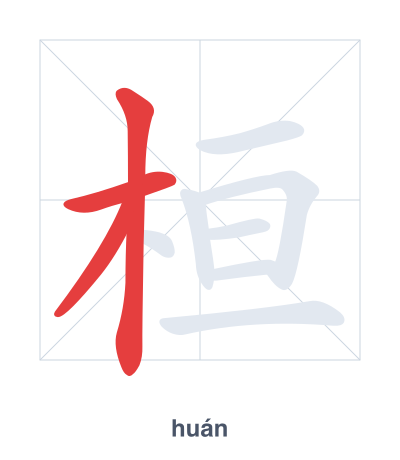
Open Hanzi Writer to see the animated stroke order and practice writing 桓 with real-time feedback.
The character 桓 (huán) is written with 10 strokes. Follow the standard Chinese stroke order: top to bottom, left to right, outside before inside. The radical 木 is one of its key components.
Practice the correct stroke order with the Hanzi Writer app to see animated stroke-by-stroke guidance with real-time feedback.
桓 means Pillar / Large tree / Valiant.
桓 combines the radical 木 (tree) with 亘 (xuān, meaning 'extending' or 'continuous'). The original sense is a large tree that stands tall and unwavering like a pillar, later extended to mean 'valiant' or 'pillar-like.'
💡 Memory Tip: Imagine a massive tree (木) with a sun (日) trapped between two horizontal lines, standing so firm and straight that it becomes a pillar of strength.
齐桓公是古代的名人。
qí huán gōng shì gǔ dài de míng rén
Duke Huan of Qi was a famous person in ancient times.
这位将军威风桓桓。
zhè wèi jiāng jūn wēi fēng huán huán
This general has a majestic and imposing appearance.
桓表是古代的一种建筑。
huán biǎo shì gǔ dài de yī zhǒng jiàn zhù
The memorial pillar is a type of ancient architecture.
Open Hanzi Writer to see the animated stroke order and practice writing 桓 with real-time feedback.
✨ Animated stroke order · Handwriting recognition · HSK-graded practice · Free to use
桓 is composed of the radical 木 (tree) on the left and 亘 (huán, meaning 'extend across') on the right. The tree radical suggests its original meaning of a large tree or pillar, while 亘 hints at strength and endurance across time.