煳 (hú) means "burnt; scorched" in Chinese. It has 13 strokes with the radical 火.
Rated 4.2/5 in difficulty (advanced).
Appears in 3+ common words including 烧煳 (shāo hú), 煳味 (hú wèi), 弄煳 (nòng hú).
Due to its 13 strokes, Hanzi Writer's error detection shows 煳 requires focused practice — most learners need 10+ attempts for consistent accuracy.
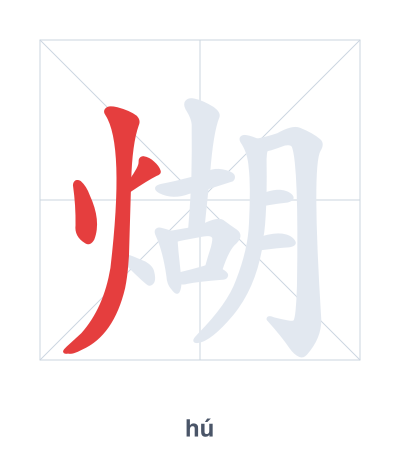
Open Hanzi Writer to see the animated stroke order and practice writing 煳 with real-time feedback.
The character 煳 (hú) is written with 13 strokes. Follow the standard Chinese stroke order: top to bottom, left to right, outside before inside. The radical 火 is one of its key components.
Practice the correct stroke order with the Hanzi Writer app to see animated stroke-by-stroke guidance with real-time feedback.
煳 means burnt; scorched.
This compound character combines the radical 火 (fire) with 胡 (hú), which provides the sound and hints at something messy or foreign; together, they depict food left too long on the fire until it becomes black and scorched.
💡 Memory Tip: Picture a pot of 胡 (胡 means 'reckless') left on 火 (fire) for too long, and a billowing cloud of smoke spells out 'HUH?!' as your dinner turns to charcoal.
菜被我烧煳了。
cài bèi wǒ shāo hú le
I burned the dish.
厨房里有一股煳味。
chú fáng lǐ yǒu yī gǔ hú wèi
There is a burnt smell in the kitchen.
别把米饭弄煳了。
bié bǎ mǐ fàn nòng hú le
Don't burn the rice.
Open Hanzi Writer to see the animated stroke order and practice writing 煳 with real-time feedback.
✨ Animated stroke order · Handwriting recognition · HSK-graded practice · Free to use
The character 煳 is made of the radical 火 (fire) on the left and the phonetic component 胡 (hú) on the right. The fire radical directly connects to the meaning of burning or scorching, while 胡 provides the pronunciation. Together, they form a character that describes something damaged by fire, such as burnt food.