烀 (hū) means "to simmer / to steam-cook" in Chinese. It has 9 strokes with the radical 火.
Rated 4/5 in difficulty (challenging).
Appears in 3+ common words including 烀玉米 (hū yù mǐ), 烀土豆 (hū tǔ dòu), 烀肉 (hū ròu).
Due to its 9 strokes, Hanzi Writer's error detection shows 烀 requires focused practice — most learners need 10+ attempts for consistent accuracy.
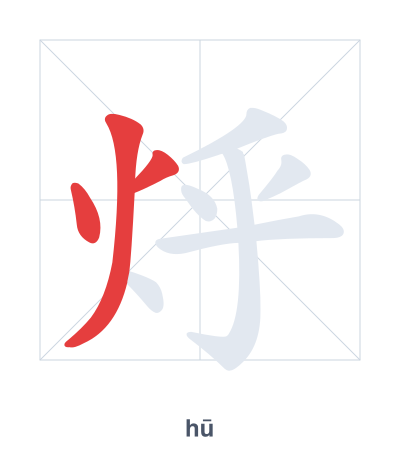
Open Hanzi Writer to see the animated stroke order and practice writing 烀 with real-time feedback.
The character 烀 (hū) is written with 9 strokes. Follow the standard Chinese stroke order: top to bottom, left to right, outside before inside. The radical 火 is one of its key components.
Practice the correct stroke order with the Hanzi Writer app to see animated stroke-by-stroke guidance with real-time feedback.
烀 means to simmer / to steam-cook.
烀 is a compound character with the radical 火 (fire) on the left, indicating heat, and the phonetic component 乎 (hū) on the right, which primarily provides the pronunciation. The character combines the concept of fire with the sound to convey a cooking method involving gentle heat and steam, akin to simmering or steaming in a covered pot.
💡 Memory Tip: Picture a steaming pot over a fire (火) that's letting out a soft 'hū' sound (乎) as it gently simmers.
锅里正在烀玉米。
guō lǐ zhèng zài hū yù mǐ
Corn is being boiled in the pot.
烀土豆很好吃。
hū tǔ dòu hěn hǎo chī
Simmered potatoes are delicious.
妈妈在烀肉。
mā mā zài hū ròu
Mom is boiling meat.
Open Hanzi Writer to see the animated stroke order and practice writing 烀 with real-time feedback.
✨ Animated stroke order · Handwriting recognition · HSK-graded practice · Free to use
烀 is made of two parts: the left radical 火 (fire) and the right part 乎 (hū) which gives the sound. Fire shows that the action involves heat, and together they mean to cook by simmering or steaming with fire.