桁 (héng) means "beam; purlin" in Chinese. It has 10 strokes with the radical 木.
Rated 4.2/5 in difficulty (advanced).
Appears in 3+ common words including 桁架 (héng jià), 衣桁 (yī héng), 桁条 (héng tiáo).
Due to its 10 strokes, Hanzi Writer's error detection shows 桁 requires focused practice — most learners need 10+ attempts for consistent accuracy.
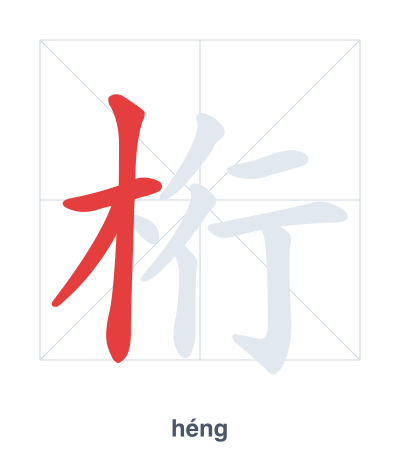
Open Hanzi Writer to see the animated stroke order and practice writing 桁 with real-time feedback.
The character 桁 (héng) is written with 10 strokes. Follow the standard Chinese stroke order: top to bottom, left to right, outside before inside. The radical 木 is one of its key components.
Practice the correct stroke order with the Hanzi Writer app to see animated stroke-by-stroke guidance with real-time feedback.
桁 means beam; purlin.
桁 is a phono-semantic compound: the left side 木 (wood) indicates the material, and the right side 行 (háng/héng) provides phonetic cues. It originally referred to a horizontal wooden beam or purlin used in traditional Chinese architecture to support roof tiles.
💡 Memory Tip: Picture walking (行) on a narrow wooden beam (木) balanced high above ground, gripping it as your purlin.
这个桁架非常结实。
zhè ge héng jià fēi cháng jiē shí
This truss is very sturdy.
衣服挂在衣桁上面。
yī fú guà zài yī héng shàng miàn
The clothes are hanging on the clothes rack.
房顶上有很多桁条。
fáng dǐng shàng yǒu hěn duō héng tiáo
There are many purlins on the roof.
Open Hanzi Writer to see the animated stroke order and practice writing 桁 with real-time feedback.
✨ Animated stroke order · Handwriting recognition · HSK-graded practice · Free to use
桁 combines the radical 木 (wood/tree) on the left with the phonetic component 行 (háng, meaning row or line) on the right. The wood radical indicates the character relates to wooden building materials, while 行 hints at beams that run in lines across a structure. Together, they create the meaning of a horizontal beam or purlin in traditional timber framing.