昊 (hào) means "vast (sky); heaven" in Chinese. It has 8 strokes with the radical 日.
Rated 3.7/5 in difficulty (challenging).
Appears in 3+ common words including 昊天 (hào tiān), 昊苍 (hào cāng), 昊大 (hào dà).
Due to its 8 strokes, Hanzi Writer's error detection shows 昊 requires focused practice — most learners need 10+ attempts for consistent accuracy.
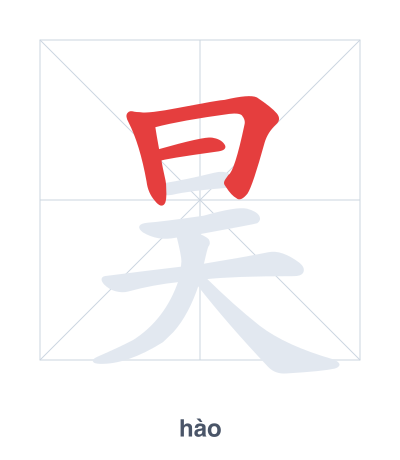
Open Hanzi Writer to see the animated stroke order and practice writing 昊 with real-time feedback.
The character 昊 (hào) is written with 8 strokes. Follow the standard Chinese stroke order: top to bottom, left to right, outside before inside. The radical 日 is one of its key components.
Practice the correct stroke order with the Hanzi Writer app to see animated stroke-by-stroke guidance with real-time feedback.
昊 means vast (sky); heaven.
昊 combines the radical 日 'sun' above 天 'sky/heaven,' literally depicting the sun reigning over the heavens. This composition evokes the boundless, bright expanse of the sky, emphasizing its vastness and grandeur.
💡 Memory Tip: Imagine the sun (日) perched on top of the sky (天) like a giant golden crown, ruling over the endless heavens.
昊天非常广阔。
hào tiān fēi cháng guǎng kuò
The vast sky is very broad.
昊苍指的就是天。
hào cāng zhǐ de jiù shì tiān
'Haocang' refers to the sky.
他的恩情很昊大。
tā de ēn qíng hěn hào dà
His kindness is as vast as the sky.
Open Hanzi Writer to see the animated stroke order and practice writing 昊 with real-time feedback.
✨ Animated stroke order · Handwriting recognition · HSK-graded practice · Free to use
昊 is made of 日 (sun) on top and 天 (sky) below. The sun in the sky suggests brightness and vastness, which connects to the meaning of "vast sky" or "heaven."