珩 (háng) means "Top gem of a pendant" in Chinese. It has 10 strokes with the radical 王.
Rated 4.2/5 in difficulty (advanced).
Appears in 3+ common words including 佩珩 (pèi háng), 珩磨 (háng mó), 珩佩 (háng pèi).
Due to its 10 strokes, Hanzi Writer's error detection shows 珩 requires focused practice — most learners need 10+ attempts for consistent accuracy.
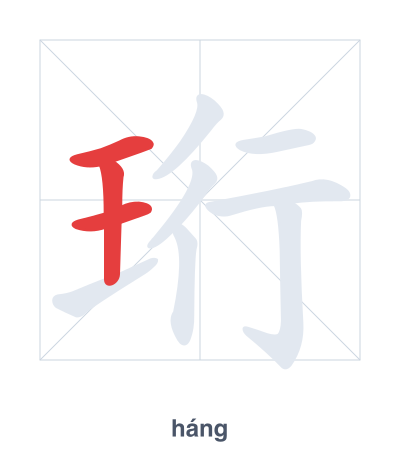
Open Hanzi Writer to see the animated stroke order and practice writing 珩 with real-time feedback.
The character 珩 (háng) is written with 10 strokes. Follow the standard Chinese stroke order: top to bottom, left to right, outside before inside. The radical 王 is one of its key components.
Practice the correct stroke order with the Hanzi Writer app to see animated stroke-by-stroke guidance with real-time feedback.
珩 means Top gem of a pendant.
珩 is a phono-semantic compound: the left radical 王 (jade) indicates a gemstone, and the right component 行 (háng, 'row' or 'to walk') provides the pronunciation while subtly evoking the row of gems in a pendant, where 珩 is the topmost piece.
💡 Memory Tip: Imagine a jade king (王) walking (行) with a magnificent pendant, the top gem (珩) sparkling at the end of the string.
他戴着佩珩。
tā dài zhe pèi háng
He is wearing a jade pendant ornament.
珩磨需要时间。
háng mó xū yào shí jiān
Honing takes time.
珩佩很精致。
háng pèi hěn jīng zhì
The jade pendant is very exquisite.
Open Hanzi Writer to see the animated stroke order and practice writing 珩 with real-time feedback.
✨ Animated stroke order · Handwriting recognition · HSK-graded practice · Free to use
The character 珩 combines the radical 王 (jade) on the left with the phonetic component 行 (xíng/háng) on the right. The left part indicates that the character relates to jade or precious stones, while the right part hints at its original pronunciation. Together they describe a jade ornament worn on a pendant, specifically the top gem.