焓 (hán) means "enthalpy" in Chinese. It has 11 strokes with the radical 火.
Rated 4.2/5 in difficulty (advanced).
Appears in 3+ common words including 焓值 (hán zhí), 焓变 (hán biàn), 比焓 (bǐ hán).
Due to its 11 strokes, Hanzi Writer's error detection shows 焓 requires focused practice — most learners need 10+ attempts for consistent accuracy.
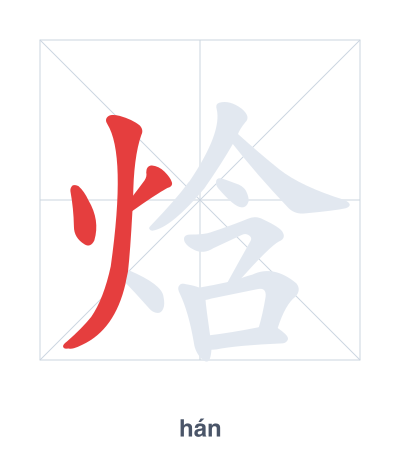
Open Hanzi Writer to see the animated stroke order and practice writing 焓 with real-time feedback.
The character 焓 (hán) is written with 11 strokes. Follow the standard Chinese stroke order: top to bottom, left to right, outside before inside. The radical 火 is one of its key components.
Practice the correct stroke order with the Hanzi Writer app to see animated stroke-by-stroke guidance with real-time feedback.
焓 means enthalpy.
焓 is a phono-semantic compound. The radical 火 (fire) indicates its connection to heat or energy, while the component 含 (hán, meaning 'to contain') provides the pronunciation and hints at the concept of 'contained heat'—enthalpy is a measure of heat content in a thermodynamic system.
💡 Memory Tip: Picture a fiery furnace (火) with a sealed lid (含 = 今 + 口) trapping all the heat inside—that's the stored energy of enthalpy.
我们需要计算焓值。
wǒ men xū yào jì suàn hán zhí
We need to calculate the enthalpy value.
这个反应的焓变是负的。
zhè ge fǎn yìng de hán biàn shì fù de
The enthalpy change of this reaction is negative.
比焓是一个热力学参数。
bǐ hán shì yí gè rè lì xué cān shù
Specific enthalpy is a thermodynamic parameter.
Open Hanzi Writer to see the animated stroke order and practice writing 焓 with real-time feedback.
✨ Animated stroke order · Handwriting recognition · HSK-graded practice · Free to use
焓 is made of two parts: the left radical 火 (fire) and the right side 含 (contain). The fire radical suggests heat, and 含 means "to contain" — together they represent "enthalpy," which is the heat content stored in a system.