Hanzi Writer

How to Write 鼾 (hān) — Meaning “To snore”

hān 17 strokes Radical: 鼻

鼾 (hān) means "To snore" in Chinese. It has 17 strokes with the radical 鼻.

Rated 4.2/5 in difficulty (advanced).

Appears in 3+ common words including 打鼾 (dǎ hān), 鼾声 (hān shēng), 鼾睡 (hān shuì).

Due to its 17 strokes, Hanzi Writer's error detection shows 鼾 requires focused practice — most learners need 10+ attempts for consistent accuracy.
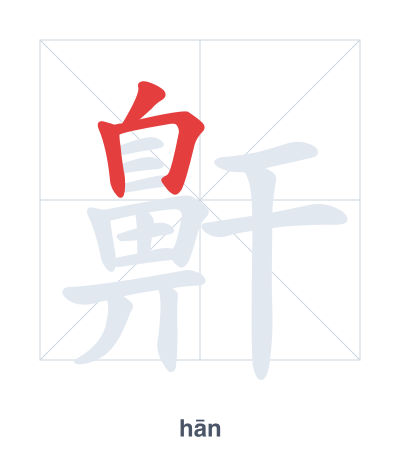
Stroke order practice for 鼾 - hān

Practice Writing 鼾 (hān)

Open Hanzi Writer to see the animated stroke order and practice writing 鼾 with real-time feedback.

The character (hān) is written with 17 strokes. Follow the standard Chinese stroke order: top to bottom, left to right, outside before inside. The radical is one of its key components.

Practice the correct stroke order with the Hanzi Writer app to see animated stroke-by-stroke guidance with real-time feedback.

means To snore.

Character
Pinyinhān (han)
MeaningTo snore
Strokes17
Radical
Difficulty4.2/5

鼾 is a compound character formed from the radical 鼻 (nose) and the phonetic component 干 (gān, meaning 'dry' or 'shield'). Since snoring is a sound produced through the nose, the radical directly conveys the meaning, while 干 hints at the pronunciation. Together, they depict the noisy breathing of a sleeping person.

💡 Memory Tip: Imagine a nose (鼻) snoring so loudly that it dries out (干) the air with a raspy, rattling sound.

dǎ hān
to snore
hān shēng
The sound of snoring
hān shuì
To sleep soundly with snoring

他睡觉爱打鼾。

tā shuì jiào ài dǎ hān

He likes to snore when he sleeps.

我听到了他的鼾声。

wǒ tīng dào le tā de hān shēng

I heard his snoring.

他在沙发上鼾睡。

tā zài shā fā shàng hān shuì

He is snoring on the sofa.

Character Pinyin Strokes Radical
(current) hān 17
qiú 16
Stroke order practice for 鼾 - hān

Practice Writing 鼾 (hān)

Open Hanzi Writer to see the animated stroke order and practice writing 鼾 with real-time feedback.

✨ Animated stroke order · Handwriting recognition · HSK-graded practice · Free to use

Frequently Asked Questions about 鼾

The character 鼾 is made up of the radical 鼻 (nose) on the left and the phonetic component 干 (gān) on the right. Since snoring happens through the nose, the radical 鼻 directly points to the meaning. The right side 干 gives a clue to the pronunciation "hān" but does not contribute to the meaning.

Characters with Radical 鼻

Other 17-Stroke Characters