莞 (guǎn/wǎn) means "smile; (also a place name Dongguan)" in Chinese. It has 10 strokes with the radical 艹.
Rated 4.2/5 in difficulty (advanced).
Appears in 3+ common words including 东莞 (dōng guǎn), 莞尔 (wǎn ěr), 莞草 (guǎn cǎo).
Due to its 10 strokes, Hanzi Writer's error detection shows 莞 requires focused practice — most learners need 10+ attempts for consistent accuracy.
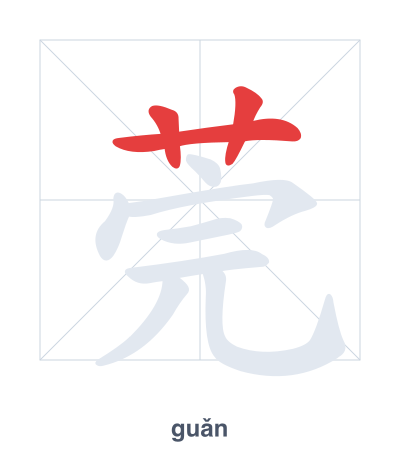
Open Hanzi Writer to see the animated stroke order and practice writing 莞 with real-time feedback.
The character 莞 (guǎn/wǎn) is written with 10 strokes. Follow the standard Chinese stroke order: top to bottom, left to right, outside before inside. The radical 艹 is one of its key components.
Practice the correct stroke order with the Hanzi Writer app to see animated stroke-by-stroke guidance with real-time feedback.
莞 means smile; (also a place name Dongguan).
This is a polyphonic character with readings: guǎn, wǎn.
This character is a compound of the grass radical 艹 and the phonetic component 完 (wán, meaning 'complete'). Originally it referred to a type of sedge plant used for weaving mats. The meaning 'smile' comes from the phrase 莞尔 (guǎn'ěr), where the character was borrowed for its sound to describe a gentle smile.
💡 Memory Tip: Picture a field of grass (艹) that is perfectly complete (完), making you smile at the beautiful sight.
他在东莞工作了三年。
tā zài dōng guǎn gōng zuò le sān nián
He worked in Dongguan for three years.
她听了这话莞尔一笑。
tā tīng le zhè huà wǎn ěr yí xiào
She gave a faint smile after hearing this.
莞草可以用来织席子。
guǎn cǎo kě yǐ yòng lái zhī xí zi
Scirpus can be used to weave mats.
Open Hanzi Writer to see the animated stroke order and practice writing 莞 with real-time feedback.
✨ Animated stroke order · Handwriting recognition · HSK-graded practice · Free to use
莞 is made of the grass radical 艹 on top and 完 underneath. The radical indicates it relates to plants, like in 莞草 (a type of grass), while the bottom part 完 provides the sound for some pronunciations, like in 东莞 (Dongguan). The meaning "smile" comes from a different reading (wǎn), as in 莞尔, where the character is used phonetically.