锢 (gù) means "To confine / To restrain" in Chinese. It has 13 strokes with the radical 钅.
Rated 4.2/5 in difficulty (advanced).
Appears in 3+ common words including 禁锢 (jìn gù), 锢定 (gù dìng), 锢闭 (gù bì).
Due to its 13 strokes, Hanzi Writer's error detection shows 锢 requires focused practice — most learners need 10+ attempts for consistent accuracy.
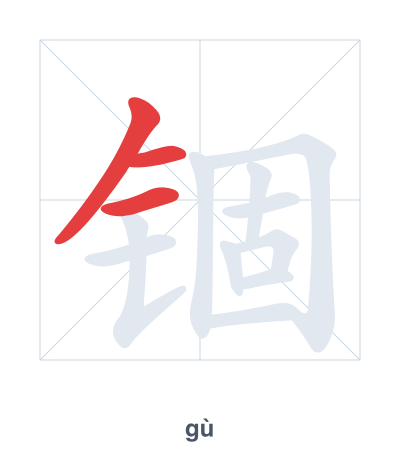
Open Hanzi Writer to see the animated stroke order and practice writing 锢 with real-time feedback.
The character 锢 (gù) is written with 13 strokes. Follow the standard Chinese stroke order: top to bottom, left to right, outside before inside. The radical 钅 is one of its key components.
Practice the correct stroke order with the Hanzi Writer app to see animated stroke-by-stroke guidance with real-time feedback.
锢 means To confine / To restrain.
The character 锢 combines the radical 钅 (metal) with 固 (solid, firm), suggesting something made of metal that is fixed in place. Since metal can be used to lock or secure objects, the compound means to confine or restrain someone or something.
💡 Memory Tip: Picture a metal (钅) lock that is so solid (固) it traps a person inside a room, confining them completely.
思想不应被禁锢。
sī xiǎng bù yīng bèi jìn gù
Thought should not be imprisoned.
把零件锢定好。
bǎ líng jiàn gù dìng hǎo
Fasten the parts securely.
门窗被锢闭了。
mén chuāng bèi gù bì le
The doors and windows were sealed shut.
Open Hanzi Writer to see the animated stroke order and practice writing 锢 with real-time feedback.
✨ Animated stroke order · Handwriting recognition · HSK-graded practice · Free to use
钅 (the metal radical) suggests something made of metal, like shackles or chains. 固 means "firm" or "solid" and gives the sound while also reinforcing the idea of being fixed or locked in place. Together, they create the meaning of confining or restraining with a metal object.