苟 (gǒu) means "careless / if / surname Gou" in Chinese. It has 8 strokes with the radical 艹.
Rated 3.7/5 in difficulty (challenging).
Appears in 3+ common words including 一丝不苟 (yī sī bù gǒu), 苟且 (gǒu qiě), 姓苟 (xìng gǒu).
Due to its 8 strokes, Hanzi Writer's error detection shows 苟 requires focused practice — most learners need 10+ attempts for consistent accuracy.
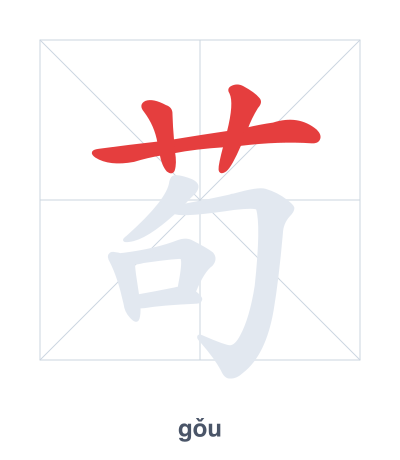
Open Hanzi Writer to see the animated stroke order and practice writing 苟 with real-time feedback.
The character 苟 (gǒu) is written with 8 strokes. Follow the standard Chinese stroke order: top to bottom, left to right, outside before inside. The radical 艹 is one of its key components.
Practice the correct stroke order with the Hanzi Writer app to see animated stroke-by-stroke guidance with real-time feedback.
苟 means careless / if / surname Gou.
苟 combines the grass radical (艹) with 句 (jù, meaning 'sentence' or 'phrase'), suggesting something as fleeting as grass in speech—hence the meanings 'careless' or 'if' (a conditional, like a temporary possibility).
💡 Memory Tip: Picture a person lying on grass (艹) while saying “if” (句) in a carefree, lazy tone.
他做事一丝不苟。
tā zuò shì yī sī bù gǒu
He is meticulous in everything he does.
生活不能太苟且。
shēng huó bù néng tài gǒu qiě
Life should not be lived aimlessly or carelessly.
我的老师姓苟。
wǒ de lǎo shī xìng gǒu
My teacher's surname is Gou.
Open Hanzi Writer to see the animated stroke order and practice writing 苟 with real-time feedback.
✨ Animated stroke order · Handwriting recognition · HSK-graded practice · Free to use
苟 is composed of the grass radical 艹 on top and the character 句 (sentence) below. The grass part suggests something trivial or plant-like, while 句 gives the sound, but the meaning "careless" comes from historical borrowing rather than a direct visual link. So the structure helps with pronunciation but not meaning.