庚 (gēng) means "The seventh of the ten Heavenly Stems" in Chinese. It has 8 strokes with the radical 广.
Rated 3.7/5 in difficulty (challenging).
Appears in 3+ common words including 同庚 (tóng gēng), 庚子 (gēng zi), 年庚 (nián gēng).
Due to its 8 strokes, Hanzi Writer's error detection shows 庚 requires focused practice — most learners need 10+ attempts for consistent accuracy.
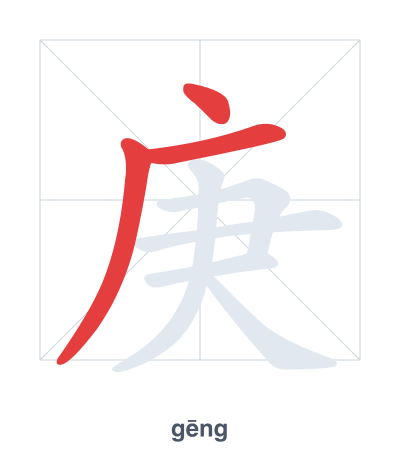
Open Hanzi Writer to see the animated stroke order and practice writing 庚 with real-time feedback.
The character 庚 (gēng) is written with 8 strokes. Follow the standard Chinese stroke order: top to bottom, left to right, outside before inside. The radical 广 is one of its key components.
Practice the correct stroke order with the Hanzi Writer app to see animated stroke-by-stroke guidance with real-time feedback.
庚 means The seventh of the ten Heavenly Stems.
In ancient oracle bone script, 庚 was a pictograph of a fish, symbolizing the seventh Heavenly Stem. The shape later evolved into the current form with the 广 radical, but the original meaning relates to this cyclical celestial stem.
💡 Memory Tip: Picture a fish (庚) under a roof (广) banging a drum seven times to announce the seventh Heavenly Stem 'gēng'.
我们两人同庚。
wǒ men liǎng rén tóng gēng
The two of us are of the same age.
今年是庚子年。
jīn nián shì gēng zi nián
This year is the Gengzi year (Year of the Metal Rat).
请写下你的年庚。
qǐng xiě xià nǐ de nián gēng
Please write down your age.
Open Hanzi Writer to see the animated stroke order and practice writing 庚 with real-time feedback.
✨ Animated stroke order · Handwriting recognition · HSK-graded practice · Free to use
The character 庚 has the radical 广 (yǎn) on top, which means a shelter or roof. The lower part is a unique component that does not directly show its meaning; instead, the whole character is used as the seventh Heavenly Stem in the Chinese calendar. Its structure does not visually represent its meaning today.