杠 (gàng) means "bar; lever" in Chinese. It has 7 strokes with the radical 木, and is HSK Level 7.
Rated 3.5/5 in difficulty (challenging).
Harder than 18% of HSK Level 7 characters.
Appears in 3+ common words including 杠杆 (gàng gǎn), 单杠 (dān gàng), 杠铃 (gàng líng).
Due to its 7 strokes, Hanzi Writer's error detection shows 杠 requires focused practice — most learners need 10+ attempts for consistent accuracy.
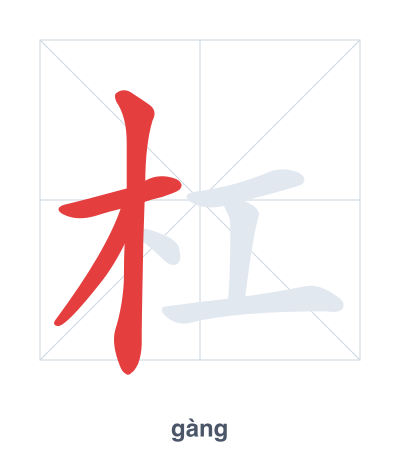
Open Hanzi Writer to see the animated stroke order and practice writing 杠 with real-time feedback.
The character 杠 (gàng) is written with 7 strokes. Follow the standard Chinese stroke order: top to bottom, left to right, outside before inside. The radical 木 is one of its key components.
Practice the correct stroke order with the Hanzi Writer app to see animated stroke-by-stroke guidance with real-time feedback.
杠 means bar; lever.
As an HSK Level 7 character, 杠 is an intermediate-level character.
杠 combines the radical 木 (wood) with the phonetic component 工 (gōng, meaning 'work' or 'worker'), indicating a wooden implement used for work. Historically, it referred to a wooden bar or lever for lifting or prying objects.
💡 Memory Tip: Imagine a strong wooden bar (木) being used by a worker (工) to pry open a heavy crate with a satisfying *creak*.
这是一个杠杆。
zhè shì yí gè gàng gǎn
This is a lever.
他在练习单杠。
tā zài liàn xí dān gàng
He is practicing on the horizontal bar.
他举起了杠铃。
tā jǔ qǐ le gàng líng
He lifted the barbell.
Open Hanzi Writer to see the animated stroke order and practice writing 杠 with real-time feedback.
✨ Animated stroke order · Handwriting recognition · HSK-graded practice · Free to use
杠 is made of the radical 木 (wood/tree) on the left and the component 工 (work) on the right. Since 木 suggests a wooden object, and 工 can imply a tool or structure, together they create the idea of a wooden bar or lever used for work. This matches the character's core meanings of 'bar' and 'lever'.