肛 (gāng) means "Anus." in Chinese. It has 7 strokes with the radical 月.
Rated 3.5/5 in difficulty (challenging).
Appears in 3+ common words including 肛门 (gāng mén), 脱肛 (tuō gāng), 肛周 (gāng zhōu).
Due to its 7 strokes, Hanzi Writer's error detection shows 肛 requires focused practice — most learners need 10+ attempts for consistent accuracy.
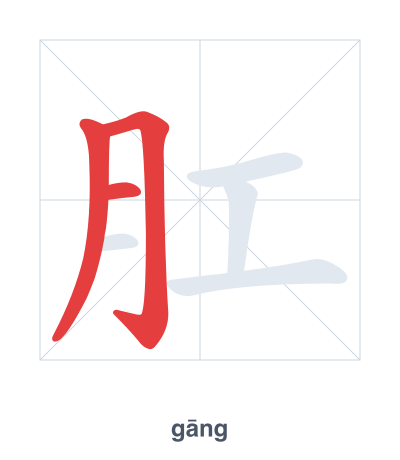
Open Hanzi Writer to see the animated stroke order and practice writing 肛 with real-time feedback.
The character 肛 (gāng) is written with 7 strokes. Follow the standard Chinese stroke order: top to bottom, left to right, outside before inside. The radical 月 is one of its key components.
Practice the correct stroke order with the Hanzi Writer app to see animated stroke-by-stroke guidance with real-time feedback.
肛 means Anus..
肛 is a phono-semantic compound. The left radical 月 (flesh/body part) indicates it relates to the body, while the right component 工 (gōng, 'work') provides the pronunciation. Together, they form the character for 'anus,' a bodily opening associated with excretion.
💡 Memory Tip: Imagine a crescent moon (月) shaped like a rear end, with a little worker (工) standing at its opening, ready to go to work.
肛门是消化器官。
gāng mén shì xiāo huà qì guān
The anus is a digestive organ.
他有脱肛的问题。
tā yǒu tuō gāng de wèn tí
He has a problem with rectal prolapse.
保持肛周清洁。
bǎo chí gāng zhōu qīng jié
Keep the perianal area clean.
Open Hanzi Writer to see the animated stroke order and practice writing 肛 with real-time feedback.
✨ Animated stroke order · Handwriting recognition · HSK-graded practice · Free to use
The character 肛 is composed of the radical 月 (flesh/body) on the left side and the phonetic component 工 (gōng) on the right. The radical 月 indicates that the character relates to a body part, while 工 provides pronunciation. Together they form the character for the body part "anus."