泔 (gān) means "Slop; swill" in Chinese. It has 8 strokes with the radical 氵.
Rated 3.7/5 in difficulty (challenging).
Appears in 3+ common words including 泔水 (gān shuǐ), 泔水桶 (gān shuǐ tǒng), 泔脚 (gān jiǎo).
Due to its 8 strokes, Hanzi Writer's error detection shows 泔 requires focused practice — most learners need 10+ attempts for consistent accuracy.
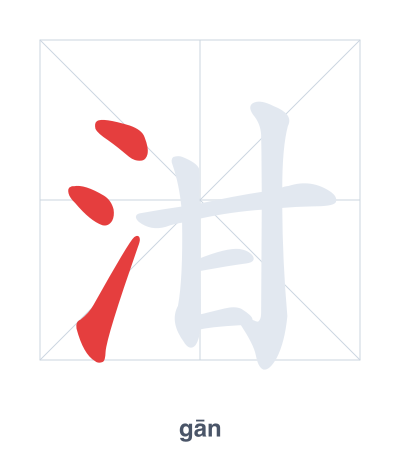
Open Hanzi Writer to see the animated stroke order and practice writing 泔 with real-time feedback.
The character 泔 (gān) is written with 8 strokes. Follow the standard Chinese stroke order: top to bottom, left to right, outside before inside. The radical 氵 is one of its key components.
Practice the correct stroke order with the Hanzi Writer app to see animated stroke-by-stroke guidance with real-time feedback.
泔 means Slop; swill.
This compound character combines the water radical 氵 with 甘 (gān, 'sweet'), which also provides the pronunciation. Originally referring to the slightly sweet water used to wash rice, 泔 came to mean any leftover liquid waste or swill from the kitchen.
💡 Memory Tip: Imagine sweet (甘) water (氵) from washing dishes gets left out too long and turns into stinky slop (泔).
泔水要倒掉。
gān shuǐ yào dào diào
The swill needs to be poured out.
泔水桶满了。
gān shuǐ tǒng mǎn le
The slop bucket is full.
这里的泔脚很多。
zhè lǐ de gān jiǎo hěn duō
There is a lot of kitchen waste here.
Open Hanzi Writer to see the animated stroke order and practice writing 泔 with real-time feedback.
✨ Animated stroke order · Handwriting recognition · HSK-graded practice · Free to use
泔 is formed from the water radical 氵 (shuǐ, water) on the left and 甘 (gān, sweet) on the right. The water radical indicates that the character refers to a liquid, while 甘 provides the sound and hints at the sweet or fermented smell often associated with kitchen waste. Together, they create the meaning of "slop" or "swill," which is leftover liquid food.