拊 (fǔ) means "To pat / To slap" in Chinese. It has 8 strokes with the radical 扌.
Rated 3.7/5 in difficulty (challenging).
Appears in 3+ common words including 拊掌 (fǔ zhǎng), 拊摩 (fǔ mó), 拊背 (fǔ bèi).
Due to its 8 strokes, Hanzi Writer's error detection shows 拊 requires focused practice — most learners need 10+ attempts for consistent accuracy.
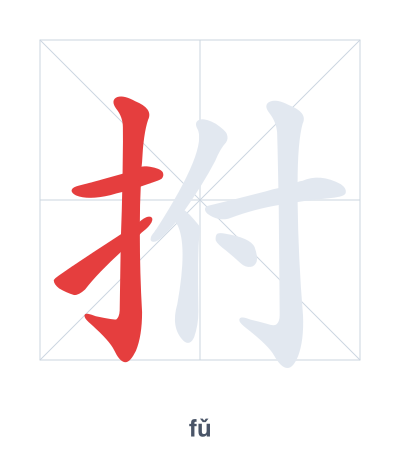
Open Hanzi Writer to see the animated stroke order and practice writing 拊 with real-time feedback.
The character 拊 (fǔ) is written with 8 strokes. Follow the standard Chinese stroke order: top to bottom, left to right, outside before inside. The radical 扌 is one of its key components.
Practice the correct stroke order with the Hanzi Writer app to see animated stroke-by-stroke guidance with real-time feedback.
拊 means To pat / To slap.
拊 is a compound character combining the hand radical 扌 (indicating an action done with the hand) with 付 (fù), which originally meant 'to give' or 'to hand over' and also contributes phonetic value. The visual suggests a hand performing a tapping or slapping motion, as if giving a quick pat or slap.
💡 Memory Tip: Picture your hand (扌) giving (付) a friendly pat on someone's back.
大家拊掌大笑。
dà jiā fǔ zhǎng dà xiào
Everyone clapped their hands and laughed loudly.
母亲拊摩着孩子。
mǔ qīn fǔ mó zhe hái zi
Mother is caressing the child.
他轻轻拊着背。
tā qīng qīng fǔ zhe bèi
He gently patted the back.
Open Hanzi Writer to see the animated stroke order and practice writing 拊 with real-time feedback.
✨ Animated stroke order · Handwriting recognition · HSK-graded practice · Free to use
拊 is formed by the radical 扌 (hand) on the left and the phonetic component 付 (fù, meaning 'to give' or 'attach') on the right. The hand radical indicates the action is done with the hand, while 付 provides pronunciation and suggests the idea of lightly placing or attaching the hand — together, they mean 'to pat' or 'to slap'.