鲕 (ér) means "Oolite" in Chinese. It has 14 strokes with the radical 鱼.
Rated 4.2/5 in difficulty (advanced).
Appears in 3+ common words including 鲕石 (ér shí), 鲕状 (ér zhuàng), 鲕粒 (ér lì).
Due to its 14 strokes, Hanzi Writer's error detection shows 鲕 requires focused practice — most learners need 10+ attempts for consistent accuracy.
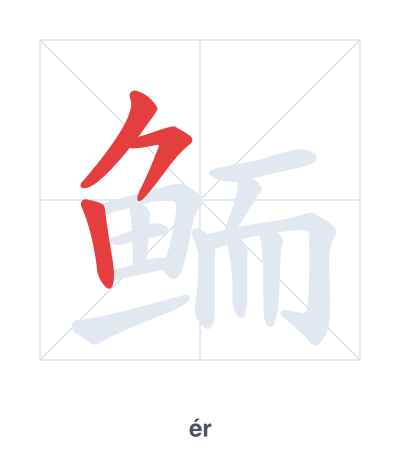
Open Hanzi Writer to see the animated stroke order and practice writing 鲕 with real-time feedback.
The character 鲕 (ér) is written with 14 strokes. Follow the standard Chinese stroke order: top to bottom, left to right, outside before inside. The radical 鱼 is one of its key components.
Practice the correct stroke order with the Hanzi Writer app to see animated stroke-by-stroke guidance with real-time feedback.
鲕 means Oolite.
The character 鲕 is a compound character with the radical 鱼 (fish) and the phonetic component 而 (ér). The fish radical suggests small round objects like fish eggs, which resemble the spherical grains of oolite. Thus, 鲕 represents oolite, a sedimentary rock made of tiny round particles.
💡 Memory Tip: Picture a fish (鱼) blowing out tiny round oolite grains that look like the symbol 而.
这种石头叫鲕石。
zhè zhǒng shí tou jiào ér shí
This kind of stone is called oolite.
它的形状是鲕状的。
tā de xíng zhuàng shì ér zhuàng de
Its shape is oolitic (like fish roe).
鲕粒非常小。
ér lì fēi cháng xiǎo
Ooliths are very small.
Open Hanzi Writer to see the animated stroke order and practice writing 鲕 with real-time feedback.
✨ Animated stroke order · Handwriting recognition · HSK-graded practice · Free to use
The left part is the radical 鱼, which means fish and hints at aquatic or marine connections. The right part is 而 (ér), which provides the pronunciation. Although the meaning "oolite" is a type of sedimentary rock, the character likely originally referred to a fish and is now used as a phonetic loan for geological terms.