陏 (duò) means "ancient place name / variant of Sui" in Chinese. It has 8 strokes with the radical 阝.
Rated 3.4/5 in difficulty (challenging).
Appears in 3+ common words including 陏陏 (duò duò), 陏县 (duò xiàn), 陏朝 (duò cháo).
Due to its 8 strokes, Hanzi Writer's error detection shows 陏 requires focused practice — most learners need 10+ attempts for consistent accuracy.
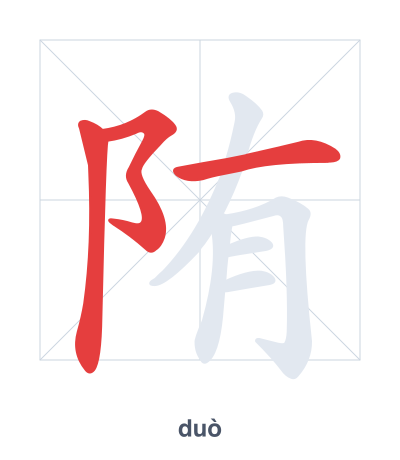
Open Hanzi Writer to see the animated stroke order and practice writing 陏 with real-time feedback.
The character 陏 (duò) is written with 8 strokes. Follow the standard Chinese stroke order: top to bottom, left to right, outside before inside. The radical 阝 is one of its key components.
Practice the correct stroke order with the Hanzi Writer app to see animated stroke-by-stroke guidance with real-time feedback.
陏 means ancient place name / variant of Sui.
陏 is a compound character: the left radical 阝 (mound/hill) indicates a place, while the right component combines 月 (moon) and 尢 (a person with a limp). Together they formed an ancient place name, later used as a variant of 随 (Sui).
💡 Memory Tip: Picture a crooked-legged man (尢) climbing a hill (阝) under a crescent moon (月) to reach the ancient place Duò (sounds like 'dough').
果实陏陏地挂在树上。
guǒ shí duò duò dì guà zài shù shàng
The fruit hangs heavily from the tree.
他出生在古陏县。
tā chū shēng zài gǔ duò xiàn
He was born in ancient Sui County.
陏朝是隋朝的异体字。
duò cháo shì suí cháo de yì tǐ zì
'Duo' is a variant character for the Sui Dynasty.
Open Hanzi Writer to see the animated stroke order and practice writing 陏 with real-time feedback.
✨ Animated stroke order · Handwriting recognition · HSK-graded practice · Free to use
陏 is made of two parts: the left radical 阝, which represents a hill or a place, and the right component 㐬, which gives the pronunciation duò. The 阝 radical indicates that the character relates to a location, which fits its meaning as an ancient place name or a variant of Sui.