硐 (dòng) means "Mine shaft" in Chinese. It has 11 strokes with the radical 石.
Rated 4.2/5 in difficulty (advanced).
Appears in 3+ common words including 山硐 (shān dòng), 硐口 (dòng kǒu), 矿硐 (kuàng dòng).
Due to its 11 strokes, Hanzi Writer's error detection shows 硐 requires focused practice — most learners need 10+ attempts for consistent accuracy.
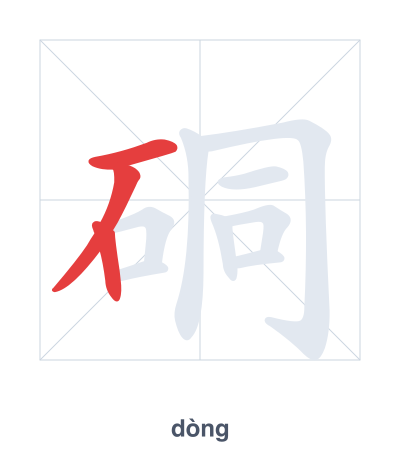
Open Hanzi Writer to see the animated stroke order and practice writing 硐 with real-time feedback.
The character 硐 (dòng) is written with 11 strokes. Follow the standard Chinese stroke order: top to bottom, left to right, outside before inside. The radical 石 is one of its key components.
Practice the correct stroke order with the Hanzi Writer app to see animated stroke-by-stroke guidance with real-time feedback.
硐 means Mine shaft.
硐 is formed from the radical 石 (stone) and the phonetic component 同 (tóng), which originally depicted a hollow or cavity. Together, they create the idea of a stone cave or tunnel, specifically a mine shaft dug into rock.
💡 Memory Tip: Picture a stone (石) with a square opening (like the inner part of 同) leading into a dark mine shaft.
这是一个大山硐。
zhè shì yí gè dà shān dòng
This is a large mountain cave.
我们在硐口集合。
wǒ men zài dòng kǒu jí hé
We are gathering at the cave entrance.
矿硐里很黑。
kuàng dòng lǐ hěn hēi
It is very dark inside the mine shaft.
Open Hanzi Writer to see the animated stroke order and practice writing 硐 with real-time feedback.
✨ Animated stroke order · Handwriting recognition · HSK-graded practice · Free to use
硐 is formed from the radical 石 (stone) on the left and 同 (same/together) on the right. The stone radical suggests a rock-related environment, while 同 hints at a tunnel or passage that goes through the rock. Together, they create the idea of a mine shaft or cavern carved into stone.