阽 (diàn) means "to be in danger" in Chinese. It has 7 strokes with the radical 阝.
Rated 3.2/5 in difficulty (challenging).
Appears in 3+ common words including 阽危 (diàn wēi), 阽死 (diàn sǐ), 阽险 (diàn xiǎn).
Due to its 7 strokes, Hanzi Writer's error detection shows 阽 requires focused practice — most learners need 10+ attempts for consistent accuracy.
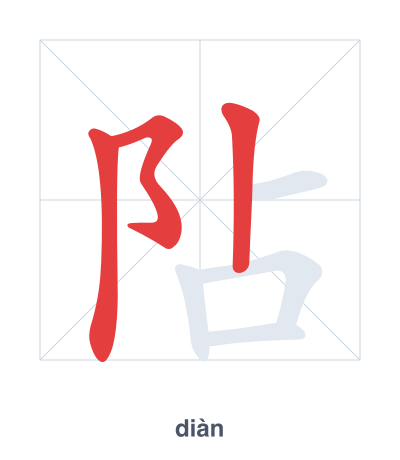
Open Hanzi Writer to see the animated stroke order and practice writing 阽 with real-time feedback.
The character 阽 (diàn) is written with 7 strokes. Follow the standard Chinese stroke order: top to bottom, left to right, outside before inside. The radical 阝 is one of its key components.
Practice the correct stroke order with the Hanzi Writer app to see animated stroke-by-stroke guidance with real-time feedback.
阽 means to be in danger.
阽 is a phono-semantic compound: the left radical 阝 (representing a mound or hill) suggests a precarious physical location, while the right component 占 (meaning to divine or occupy) provides phonetic clues. Together, they evoke the image of standing on a steep hill where a single misstep could lead to a dangerous fall, hence the meaning 'to be in danger.'
💡 Memory Tip: Picture a person standing on a mound (阝) reciting a divination (占) that predicts imminent danger of falling.
情况十分阽危。
qíng kuàng shí fēn diàn wēi
The situation is extremely precarious.
他处于阽死之地。
tā chǔ yú diàn sǐ zhī dì
He is in a state of mortal danger.
道路非常阽险。
dào lù fēi cháng diàn xiǎn
The road is very dangerous.
Open Hanzi Writer to see the animated stroke order and practice writing 阽 with real-time feedback.
✨ Animated stroke order · Handwriting recognition · HSK-graded practice · Free to use
The character 阽 is composed of the left radical 阝 (a variant of 阜, meaning mound or hill) and the right component 占 (meaning to divine or occupy). Together, they suggest a person standing on a dangerous cliff edge, needing to divine whether it is safe, hence the meaning "to be in danger."