坫 (diàn) means "stand / pedestal" in Chinese. It has 8 strokes with the radical 土.
Rated 3.7/5 in difficulty (challenging).
Appears in 3+ common words including 坫台 (diàn tái), 反坫 (fǎn diàn), 土坫 (tǔ diàn).
Due to its 8 strokes, Hanzi Writer's error detection shows 坫 requires focused practice — most learners need 10+ attempts for consistent accuracy.
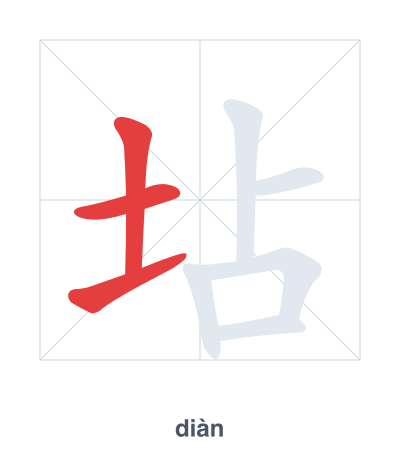
Open Hanzi Writer to see the animated stroke order and practice writing 坫 with real-time feedback.
The character 坫 (diàn) is written with 8 strokes. Follow the standard Chinese stroke order: top to bottom, left to right, outside before inside. The radical 土 is one of its key components.
Practice the correct stroke order with the Hanzi Writer app to see animated stroke-by-stroke guidance with real-time feedback.
坫 means stand / pedestal.
The character 坫 combines the radical 土 (earth/ground) with the phonetic component 占 (zhàn, meaning 'to occupy' or 'to divine'). Its original meaning was a low earthen stand or pedestal used in ancient rituals for placing wine vessels or other offerings, reflecting a raised platform made of earth.
💡 Memory Tip: Picture a square earthen pedestal (土) with a large divination tripod perched on top, taking up (占) the whole surface.
坫台上放着一个杯子。
diàn tái shàng fàng zhe yí gè bēi zi
There is a cup on the stand.
这是古代的反坫建筑。
zhè shì gǔ dài de fǎn diàn jiàn zhù
This is an ancient ritual cup stand structure.
他在院子里筑了一个土坫。
tā zài yuàn zi lǐ zhù le yí gè tǔ diàn
He built an earthen platform in the yard.
Open Hanzi Writer to see the animated stroke order and practice writing 坫 with real-time feedback.
✨ Animated stroke order · Handwriting recognition · HSK-graded practice · Free to use
坫 is formed from the radical 土 (earth) on the left, and the component 占 (occupy) on the right. The 土 shows that a stand or pedestal was originally made of earth, while 占 suggests a fixed place or position. Together, they create the idea of an earthen platform used for holding objects.