骀 (dài) means "tired horse; worn-out horse" in Chinese. It has 8 strokes with the radical 马.
Rated 3.7/5 in difficulty (challenging).
Appears in 3+ common words including 骀荡 (dài dàng), 驽骀 (nú dài), 骀背 (dài bèi).
Due to its 8 strokes, Hanzi Writer's error detection shows 骀 requires focused practice — most learners need 10+ attempts for consistent accuracy.
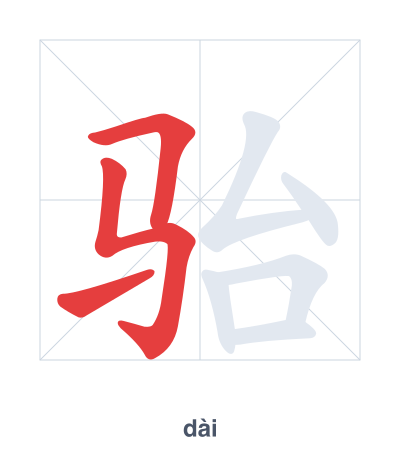
Open Hanzi Writer to see the animated stroke order and practice writing 骀 with real-time feedback.
The character 骀 (dài) is written with 8 strokes. Follow the standard Chinese stroke order: top to bottom, left to right, outside before inside. The radical 马 is one of its key components.
Practice the correct stroke order with the Hanzi Writer app to see animated stroke-by-stroke guidance with real-time feedback.
骀 means tired horse; worn-out horse.
骀 is a phono-semantic compound: the radical 马 (horse) indicates the meaning, while 台 (tái) provides the pronunciation. The character refers to a horse that is worn out or exhausted, possibly from laboring on a platform or stage.
💡 Memory Tip: Picture a horse (马) too tired to move, slumped over a platform (台) after a long day of work.
春风骀荡,天气很好。
chūn fēng dài dàng tiān qì hěn hǎo
The spring breeze is gentle and the weather is fine.
他常自谦为驽骀。
tā cháng zì qiān wèi nú dài
He often modestly refers to himself as an inferior horse.
老人骀背,步履蹒跚。
lǎo rén dài bèi bù lǚ pán shān
The elderly person is hunchbacked and walks with a stagger.
Open Hanzi Writer to see the animated stroke order and practice writing 骀 with real-time feedback.
✨ Animated stroke order · Handwriting recognition · HSK-graded practice · Free to use
The character 骀 combines the radical 马 (horse) on the left and the phonetic component 台 (tái) on the right. The horse radical directly connects to the original meaning of a tired or worn-out horse. The right side 台 provides the sound but also suggests a platform or pedestal, hinting at a horse that can no longer stand strong.