呔 (dāi) means "Hey! / Halt! (interjection)" in Chinese. It has 7 strokes with the radical 口.
Rated 3.5/5 in difficulty (challenging).
Appears in 1+ common words including 呔 (dāi).
Due to its 7 strokes, Hanzi Writer's error detection shows 呔 requires focused practice — most learners need 10+ attempts for consistent accuracy.
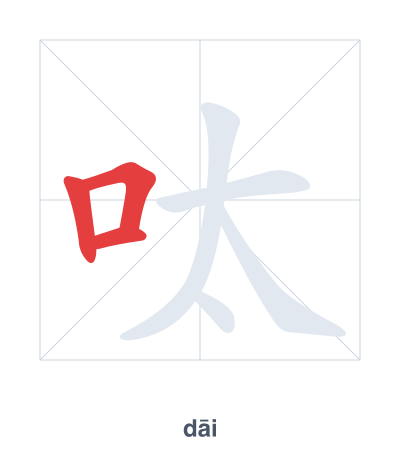
Open Hanzi Writer to see the animated stroke order and practice writing 呔 with real-time feedback.
The character 呔 (dāi) is written with 7 strokes. Follow the standard Chinese stroke order: top to bottom, left to right, outside before inside. The radical 口 is one of its key components.
Practice the correct stroke order with the Hanzi Writer app to see animated stroke-by-stroke guidance with real-time feedback.
呔 means Hey! / Halt! (interjection).
呔 compounds the mouth radical 口, indicating an utterance or sound, with 太 (tài) as a phonetic component. Originally used in ancient texts to represent a sudden exclamation or shout, it functions as an interjection meaning 'Hey!' or 'Halt!'
💡 Memory Tip: Picture a huge mouth (口) with an exaggerated tongue pointing forward, yelling a big (太) 'HEY!' to stop someone in their tracks.
呔!快停下!
dāi kuài tíng xià
Hey! Stop right there!
呔!你是谁?
dāi nǐ shì shuí
Hey! Who are you?
呔!看招!
dāi kàn zhāo
Hey! Take this!
Open Hanzi Writer to see the animated stroke order and practice writing 呔 with real-time feedback.
✨ Animated stroke order · Handwriting recognition · HSK-graded practice · Free to use
呔 is made of the radical 口 (mouth) on the left and 太 (tài) on the right. The mouth radical shows it is a sound or exclamation, and 太 provides the pronunciation hint (though the actual reading is dāi). Together they form an interjection meaning "Hey!" or "Halt!" shouted with the mouth.