雏 (chú) means "Chick; young bird; fledgling" in Chinese. It has 13 strokes with the radical 隹.
Rated 4.2/5 in difficulty (advanced).
Appears in 3+ common words including 雏鸟 (chú niǎo), 雏形 (chú xíng), 雏鸡 (chú jī).
Due to its 13 strokes, Hanzi Writer's error detection shows 雏 requires focused practice — most learners need 10+ attempts for consistent accuracy.
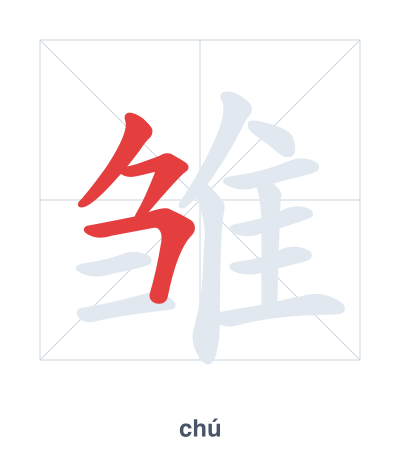
Open Hanzi Writer to see the animated stroke order and practice writing 雏 with real-time feedback.
The character 雏 (chú) is written with 13 strokes. Follow the standard Chinese stroke order: top to bottom, left to right, outside before inside. The radical 隹 is one of its key components.
Practice the correct stroke order with the Hanzi Writer app to see animated stroke-by-stroke guidance with real-time feedback.
雏 means Chick; young bird; fledgling.
| Character | 雏 |
| Pinyin | chú (chu) |
| Meaning | Chick; young bird; fledgling |
| Strokes | 13 |
| Radical | 隹 |
| Difficulty | 4.2/5 |
雏 combines 刍 (young, also phonetic 'chú') with 隹 (bird), literally meaning 'young bird'. The left component 刍 originally depicted a hand pulling grass, but here it hints at youth or immaturity, while 隹 represents the bird. Together they form the concept of a fledgling or chick.
💡 Memory Tip: Picture a tiny chick (隹) peeking out from a clump of grass (刍) in the nest.
雏鸟在窝里。
chú niǎo zài wō lǐ
The fledgling is in the nest.
计划已有雏形。
jì huà yǐ yǒu chú xíng
The plan has taken shape.
雏鸡很可爱。
chú jī hěn kě ài
The chick is very cute.
Open Hanzi Writer to see the animated stroke order and practice writing 雏 with real-time feedback.
✨ Animated stroke order · Handwriting recognition · HSK-graded practice · Free to use
The character 雏 is made of two parts: the left side 刍 (chú) meaning 'young' or 'newborn' and the right side 隹 (zhuī) meaning 'bird'. Together they form 'young bird' or 'fledgling'. The 刍 component gives the sense of immaturity, while 隹 clearly indicates a bird.