Hanzi Writer

How to Write 锄 (chú) — Meaning “Hoe; to hoe”

chú 12 strokes Radical: 钅

锄 (chú) means "Hoe; to hoe" in Chinese. It has 12 strokes with the radical 钅.

Rated 4.2/5 in difficulty (advanced).

Appears in 3+ common words including 锄头 (chú tou), 锄草 (chú cǎo), 锄地 (chú dì).

Due to its 12 strokes, Hanzi Writer's error detection shows 锄 requires focused practice — most learners need 10+ attempts for consistent accuracy.
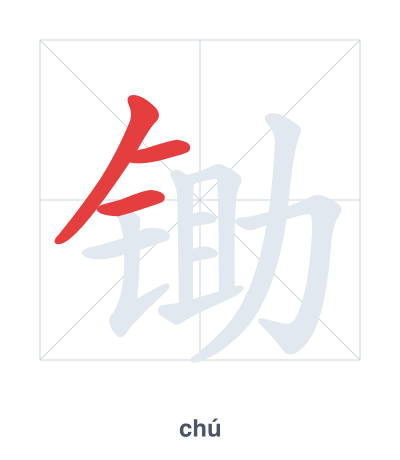
Stroke order practice for 锄 - chú

Practice Writing 锄 (chú)

Open Hanzi Writer to see the animated stroke order and practice writing 锄 with real-time feedback.

The character (chú) is written with 12 strokes. Follow the standard Chinese stroke order: top to bottom, left to right, outside before inside. The radical is one of its key components.

Practice the correct stroke order with the Hanzi Writer app to see animated stroke-by-stroke guidance with real-time feedback.

means Hoe; to hoe.

Character
Pinyinchú (chu)
MeaningHoe; to hoe
Strokes12
Radical
Difficulty4.2/5

The character 锄 combines the metal radical 钅 (jīn), indicating a tool made of metal, with 助 (zhù, 'to help'), which hints at its pronunciation and suggests the hoe's role in aiding farming work. Originally depicting a metal farming implement used for weeding and loosening soil, the form now clearly shows its material and function through this compound structure.

💡 Memory Tip: Picture a golden hoe (钅) assisting (助) a farmer by breaking up the earth with each swing.

chú tou
Hoe (tool)
chú cǎo
To weed; to hoe weeds
chú dì
To hoe the ground

农民手里拿着锄头。

nóng mín shǒu lǐ ná zhe chú tou

The farmer is holding a hoe.

他在花园里锄草。

tā zài huā yuán lǐ chú cǎo

He is weeding in the garden.

爷爷每天去田里锄地。

yé yé měi tiān qù tián lǐ chú dì

Grandpa goes to the field to hoe the ground every day.

Character Pinyin Strokes Radical
(current) chú 12
10
qián 10
zhēng 10
Stroke order practice for 锄 - chú

Practice Writing 锄 (chú)

Open Hanzi Writer to see the animated stroke order and practice writing 锄 with real-time feedback.

✨ Animated stroke order · Handwriting recognition · HSK-graded practice · Free to use

Frequently Asked Questions about 锄

锄 is made of two parts: the radical 钅 (gold/metal) on the left, and the phonetic component 助 (zhù, meaning "to help") on the right. The metal radical tells you the tool is made of metal, like a hoe blade. The right side 助 gives a clue to the pronunciation (chú) and suggests the hoe helps with farming work.

Characters with Radical 钅

Other 12-Stroke Characters