茺 (chōng) means "motherwort (often used in Chinese medicine)" in Chinese. It has 9 strokes with the radical 艹.
Rated 4/5 in difficulty (challenging).
Appears in 3+ common words including 茺蔚子 (chōng wèi zi), 茺蔚 (chōng wèi), 益母茺蔚 (yì mǔ chōng wèi).
Due to its 9 strokes, Hanzi Writer's error detection shows 茺 requires focused practice — most learners need 10+ attempts for consistent accuracy.
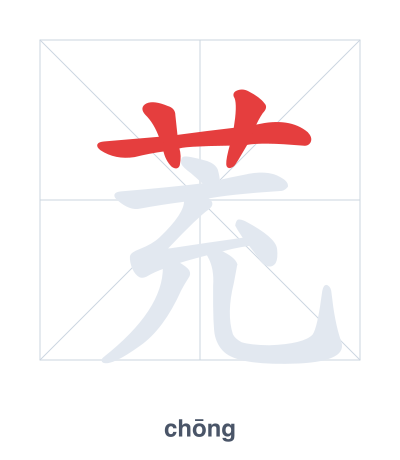
Open Hanzi Writer to see the animated stroke order and practice writing 茺 with real-time feedback.
The character 茺 (chōng) is written with 9 strokes. Follow the standard Chinese stroke order: top to bottom, left to right, outside before inside. The radical 艹 is one of its key components.
Practice the correct stroke order with the Hanzi Writer app to see animated stroke-by-stroke guidance with real-time feedback.
茺 means motherwort (often used in Chinese medicine).
茺 is a phono-semantic compound: the grass radical (艹) indicates it's a plant, while 充 (chōng) provides the sound and suggests abundance or fullness, possibly referencing how motherwort grows thickly or its traditional use to replenish vital energy.
💡 Memory Tip: Picture motherwort covering a field so fully that every blade of grass (艹) is stuffed with plant material (充).
茺蔚子可以明目。
chōng wèi zi kě yǐ míng mù
Motherwort seeds can improve eyesight.
茺蔚就是益母草。
chōng wèi jiù shì yì mǔ cǎo
Chongwei is another name for motherwort.
医生开了益母茺蔚。
yī shēng kāi le yì mǔ chōng wèi
The doctor prescribed motherwort.
Open Hanzi Writer to see the animated stroke order and practice writing 茺 with real-time feedback.
✨ Animated stroke order · Handwriting recognition · HSK-graded practice · Free to use
The character 茺 is composed of the grass radical 艹 on top and 充 (chōng, meaning "full" or "abundant") below. The grass radical indicates it is a plant, while 充 suggests the plant's vigorous growth or medicinal potency. Together, they represent motherwort, a herb known for its abundant medicinal uses.