檗 (bò) means "Amur cork tree" in Chinese. It has 17 strokes with the radical 木.
Rated 4.2/5 in difficulty (advanced).
Appears in 3+ common words including 黄檗 (huáng bò), 檗木 (bò mù), 檗皮 (bò pí).
Due to its 17 strokes, Hanzi Writer's error detection shows 檗 requires focused practice — most learners need 10+ attempts for consistent accuracy.
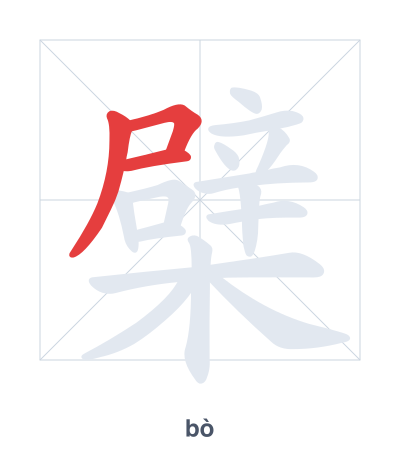
Open Hanzi Writer to see the animated stroke order and practice writing 檗 with real-time feedback.
The character 檗 (bò) is written with 17 strokes. Follow the standard Chinese stroke order: top to bottom, left to right, outside before inside. The radical 木 is one of its key components.
Practice the correct stroke order with the Hanzi Writer app to see animated stroke-by-stroke guidance with real-time feedback.
檗 means Amur cork tree.
檗 is a phono-semantic compound. The radical 木 (tree) indicates it is a type of tree, while 辟 provides the pronunciation (bò). The Amur cork tree is known for its thick, corky bark used in traditional Chinese medicine.
💡 Memory Tip: Picture a tree (木) whose bark opens (辟) to reveal cork, the Amur cork tree.
黄檗是一种中药。
huáng bò shì yī zhǒng zhōng yào
Amur cork tree is a type of traditional Chinese medicine.
檗木的颜色发黄。
bò mù de yán sè fā huáng
The color of Amur cork wood is yellowish.
檗皮的味道很苦。
bò pí de wèi dào hěn kǔ
The bark of the Amur cork tree tastes very bitter.
Open Hanzi Writer to see the animated stroke order and practice writing 檗 with real-time feedback.
✨ Animated stroke order · Handwriting recognition · HSK-graded practice · Free to use
檗 is composed of 辟 (pì) on top and 木 (mù, wood) on the bottom. The bottom radical 木 shows it is a kind of tree, while the top part 辟 hints at the pronunciation. This structure means 'Amur cork tree,' a type of tree known for its cork bark.