砭 (biān) means "stone needle / to pierce" in Chinese. It has 9 strokes with the radical 石.
Rated 4/5 in difficulty (challenging).
Appears in 3+ common words including 砭石 (biān shí), 砭骨 (biān gǔ), 针砭 (zhēn biān).
Due to its 9 strokes, Hanzi Writer's error detection shows 砭 requires focused practice — most learners need 10+ attempts for consistent accuracy.
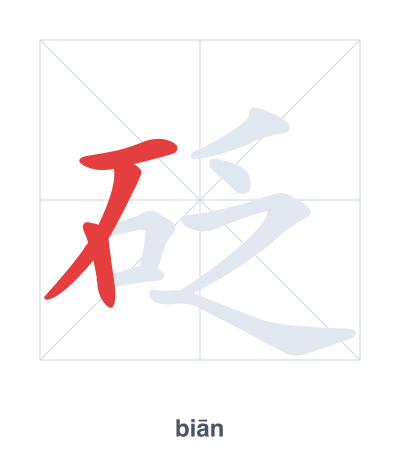
Open Hanzi Writer to see the animated stroke order and practice writing 砭 with real-time feedback.
The character 砭 (biān) is written with 9 strokes. Follow the standard Chinese stroke order: top to bottom, left to right, outside before inside. The radical 石 is one of its key components.
Practice the correct stroke order with the Hanzi Writer app to see animated stroke-by-stroke guidance with real-time feedback.
砭 means stone needle / to pierce.
砭 is a phono-semantic compound: the left radical 石 (stone) indicates that the character relates to stone tools, while the right component 乏 (fá, meaning 'lack' or 'faint') serves as a phonetic hint toward the pronunciation biān. Ancient Chinese used stone needles (砭) for acupuncture or bloodletting, so the visual form combines 'stone' with a sound element to represent a piercing medical instrument.
💡 Memory Tip: Imagine a stone (石) needle poking a person so hard they feel weak (乏) — that's the piercing tool 砭.
他在用砭石按摩。
tā zài yòng biān shí àn mó
He is massaging with a bian stone.
寒风刺骨砭骨。
hán fēng cì gǔ biān gǔ
The cold wind is bone-chilling.
他的话针砭时弊。
tā de huà zhēn biān shí bì
His words criticized the social ills of the time.
Open Hanzi Writer to see the animated stroke order and practice writing 砭 with real-time feedback.
✨ Animated stroke order · Handwriting recognition · HSK-graded practice · Free to use
砭 is made of two parts: the left radical 石 (stone) and the right side 乏 (fá). The stone radical tells you the character is about something made of stone, while the right side provides the sound. Together, they create the idea of a stone needle used for piercing.