煸 (biān) means "to stir-fry; to sauté" in Chinese. It has 13 strokes with the radical 火.
Rated 4.2/5 in difficulty (advanced).
Appears in 3+ common words including 干煸 (gàn biān), 煸炒 (biān chǎo), 煸干 (biān gàn).
Due to its 13 strokes, Hanzi Writer's error detection shows 煸 requires focused practice — most learners need 10+ attempts for consistent accuracy.
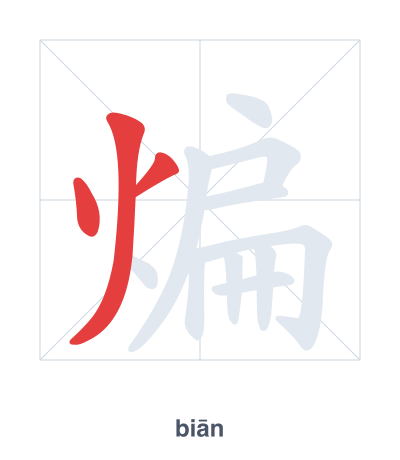
Open Hanzi Writer to see the animated stroke order and practice writing 煸 with real-time feedback.
The character 煸 (biān) is written with 13 strokes. Follow the standard Chinese stroke order: top to bottom, left to right, outside before inside. The radical 火 is one of its key components.
Practice the correct stroke order with the Hanzi Writer app to see animated stroke-by-stroke guidance with real-time feedback.
煸 means to stir-fry; to sauté.
煸 combines the radical 火 (fire) with 扁 (flat, wide), suggesting the action of cooking quickly over high heat in a flat pan. The character depicts the visual idea of something flat (like a spatula or pan) interacting with fire to stir-fry food.
💡 Memory Tip: Picture a flat pan (扁) over a fire (火) where you quickly toss vegetables to stir-fry them.
我喜欢吃干煸豆角。
wǒ xǐ huān chī gàn biān dòu jiǎo
I like eating dry-fried green beans.
先把肉片煸炒一下。
xiān bǎ ròu piàn biān chǎo yī xià
First, stir-fry the sliced meat for a bit.
把水分慢慢煸干。
bǎ shuǐ fèn màn màn biān gàn
Slowly stir-fry until the moisture evaporates.
Open Hanzi Writer to see the animated stroke order and practice writing 煸 with real-time feedback.
✨ Animated stroke order · Handwriting recognition · HSK-graded practice · Free to use
The character is composed of the radical 火 on the left, meaning fire, and 扁 on the right, which gives the sound and also suggests flattening. Together they indicate a cooking method that uses high heat to flatten and fry food.