珤 (bǎo) means "Treasure" in Chinese. It has 10 strokes with the radical 王.
Rated 4.2/5 in difficulty (advanced).
Appears in 3+ common words including 珤石 (bǎo shí), 珤贝 (bǎo bèi), 珤藏 (bǎo cáng).
Due to its 10 strokes, Hanzi Writer's error detection shows 珤 requires focused practice — most learners need 10+ attempts for consistent accuracy.
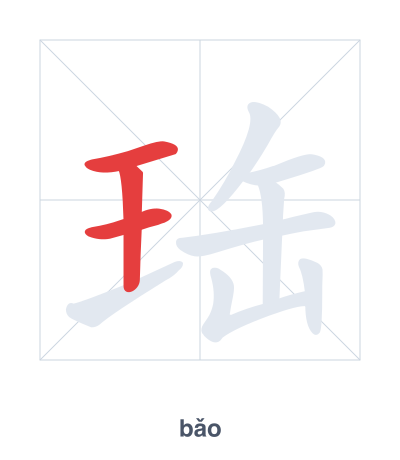
Open Hanzi Writer to see the animated stroke order and practice writing 珤 with real-time feedback.
The character 珤 (bǎo) is written with 10 strokes. Follow the standard Chinese stroke order: top to bottom, left to right, outside before inside. The radical 王 is one of its key components.
Practice the correct stroke order with the Hanzi Writer app to see animated stroke-by-stroke guidance with real-time feedback.
珤 means Treasure.
珤 is a compound character combining 王 (jade) as the radical and 缶 (a pottery jar) as the phonetic and semantic component. Together, they depict valuable jade stored inside a jar, symbolizing treasure. This character is an ancient variant of 寶 (bǎo), emphasizing the idea of precious items kept in a container.
💡 Memory Tip: Imagine a royal jade jar (王 + 缶) stuffed with gleaming gems and gold coins—that's your treasure (珤)!
他有很多珤石。
tā yǒu hěn duō bǎo shí
He has many precious stones.
珤贝在盒子里。
bǎo bèi zài hé zi lǐ
The treasure shell is in the box.
这里有珤藏。
zhè lǐ yǒu bǎo cáng
There are treasures hidden here.
Open Hanzi Writer to see the animated stroke order and practice writing 珤 with real-time feedback.
✨ Animated stroke order · Handwriting recognition · HSK-graded practice · Free to use
珤 is made of the radical 王 (jade) on the left and a phonetic component 宝 (bǎo, treasure) on the right. Since 王 relates to jade or precious things, the combination strongly hints at something valuable like a treasure.