獒 (áo) means "Mastiff" in Chinese. It has 14 strokes with the radical 犬.
Rated 4.2/5 in difficulty (advanced).
Appears in 3+ common words including 藏獒 (zàng áo), 獒犬 (áo quǎn), 獒王 (áo wáng).
Due to its 14 strokes, Hanzi Writer's error detection shows 獒 requires focused practice — most learners need 10+ attempts for consistent accuracy.
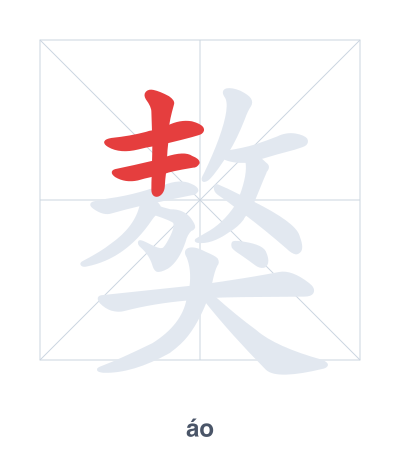
Open Hanzi Writer to see the animated stroke order and practice writing 獒 with real-time feedback.
The character 獒 (áo) is written with 14 strokes. Follow the standard Chinese stroke order: top to bottom, left to right, outside before inside. The radical 犬 is one of its key components.
Practice the correct stroke order with the Hanzi Writer app to see animated stroke-by-stroke guidance with real-time feedback.
獒 means Mastiff.
| Character | 獒 |
| Pinyin | áo (ao) |
| Meaning | Mastiff |
| Strokes | 14 |
| Radical | 犬 |
| Difficulty | 4.2/5 |
The character 獒 combines the radical 犬 (dog) with the phonetic component 敖 (áo, meaning 'proud' or 'ramble'), suggesting a large, proud, and watchful dog—a mastiff bred for guarding and hunting.
💡 Memory Tip: Picture a massive mastiff (犬) with proud, upright ears (the top of 敖) and sturdy legs (its lower part), striding boldly.
藏獒长得像狮子。
zàng áo zhǎng dé xiàng shī zi
Tibetan Mastiffs look like lions.
獒犬的力气很大。
áo quǎn de lì qì hěn dà
Mastiffs are very strong.
它是这群狗里的獒王。
tā shì zhè qún gǒu lǐ de áo wáng
It is the king of mastiffs in this pack.
Open Hanzi Writer to see the animated stroke order and practice writing 獒 with real-time feedback.
✨ Animated stroke order · Handwriting recognition · HSK-graded practice · Free to use
獒 is made of two parts: the top part 敖 (áo, meaning 'proud' or 'rampant') and the bottom part 犬 (quǎn, the dog radical). The dog radical tells you it is a type of canine, and the top part suggests the fierce, proud nature of a mastiff. Together, they create the image of a large, powerful dog.