桉 (ān) means "eucalyptus" in Chinese. It has 10 strokes with the radical 木.
Rated 4.2/5 in difficulty (advanced).
Appears in 3+ common words including 桉树 (ān shù), 桉油 (ān yóu), 桉叶 (ān yè).
Due to its 10 strokes, Hanzi Writer's error detection shows 桉 requires focused practice — most learners need 10+ attempts for consistent accuracy.
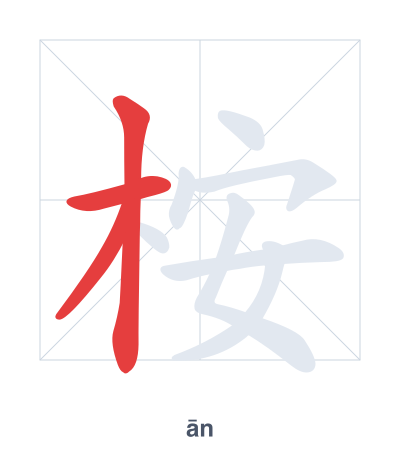
Open Hanzi Writer to see the animated stroke order and practice writing 桉 with real-time feedback.
The character 桉 (ān) is written with 10 strokes. Follow the standard Chinese stroke order: top to bottom, left to right, outside before inside. The radical 木 is one of its key components.
Practice the correct stroke order with the Hanzi Writer app to see animated stroke-by-stroke guidance with real-time feedback.
桉 means eucalyptus.
桉 is a compound character formed from the radical 木 (tree) and the phonetic component 安 (ān, meaning peace). The character was created to denote the eucalyptus tree, using 木 for its tree meaning and 安 to indicate the pronunciation.
💡 Memory Tip: Picture a eucalyptus tree (木) that feels so safe and peaceful (安) that koalas nap on its branches.
路边种了很多桉树。
lù biān zhǒng le hěn duō ān shù
Many eucalyptus trees are planted by the roadside.
这种药膏含有桉油。
zhè zhǒng yào gāo hán yǒu ān yóu
This ointment contains eucalyptus oil.
考拉喜欢吃桉叶。
kǎo lā xǐ huān chī ān yè
Koalas like to eat eucalyptus leaves.
Open Hanzi Writer to see the animated stroke order and practice writing 桉 with real-time feedback.
✨ Animated stroke order · Handwriting recognition · HSK-graded practice · Free to use
桉 is a left-right character. The left part is the radical 木 (wood), which shows it is related to trees. The right part is 安 (ān, meaning peace), which gives the pronunciation but also suggests the tree is sturdy and calm.