砹 (ài) means "astatine" in Chinese. It has 10 strokes with the radical 石.
Rated 4.2/5 in difficulty (advanced).
Appears in 3+ common words including 砹原子 (ài yuán zi), 元素砹 (yuán sù ài), 砹同位素 (ài tóng wèi sù).
Due to its 10 strokes, Hanzi Writer's error detection shows 砹 requires focused practice — most learners need 10+ attempts for consistent accuracy.
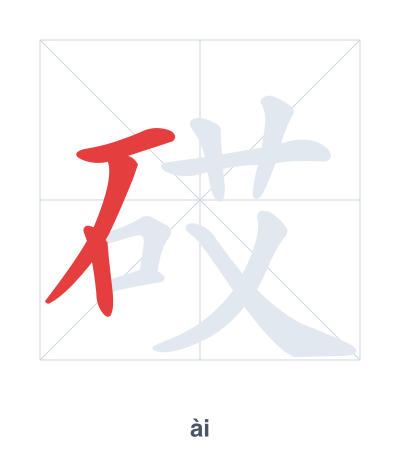
Open Hanzi Writer to see the animated stroke order and practice writing 砹 with real-time feedback.
The character 砹 (ài) is written with 10 strokes. Follow the standard Chinese stroke order: top to bottom, left to right, outside before inside. The radical 石 is one of its key components.
Practice the correct stroke order with the Hanzi Writer app to see animated stroke-by-stroke guidance with real-time feedback.
砹 means astatine.
砹 is a phono-semantic compound. The radical 石 (stone) indicates it is a solid element, while 艾 (ài, mugwort) provides the phonetic component. This character was coined to translate 'astatine', a rare radioactive halogen element.
💡 Memory Tip: Imagine a stone (石) covered with mugwort (艾) that suddenly glows and crackles with radiation, because it's made of astatine.
砹原子非常不稳定。
ài yuán zi fēi cháng bù wěn dìng
Astatine atoms are very unstable.
元素砹在自然界很少。
yuán sù ài zài zì rán jiè hěn shǎo
The element astatine is very rare in nature.
科学家研究砹同位素。
kē xué jiā yán jiū ài tóng wèi sù
Scientists study astatine isotopes.
Open Hanzi Writer to see the animated stroke order and practice writing 砹 with real-time feedback.
✨ Animated stroke order · Handwriting recognition · HSK-graded practice · Free to use
砹 is composed of two parts: the radical 石 on the left, meaning 'stone' or 'rock,' and the phonetic component 艾 on the right, which gives the pronunciation ài. The 石 radical is often used in Chinese characters for solid chemical elements, so it hints that 砹 refers to a solid element—astatine. The right part 艾 does not directly contribute to the meaning but provides the sound.