炷 (zhù) means "stick (of incense)" in Chinese. It has 9 strokes with the radical 火.
Rated 4/5 in difficulty (challenging).
Appears in 3+ common words including 一炷香 (yī zhù xiāng), 灯炷 (dēng zhù), 炷香 (zhù xiāng).
Due to its 9 strokes, Hanzi Writer's error detection shows 炷 requires focused practice — most learners need 10+ attempts for consistent accuracy.
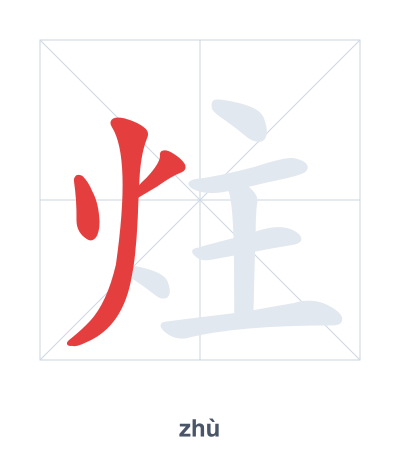
Open Hanzi Writer to see the animated stroke order and practice writing 炷 with real-time feedback.
The character 炷 (zhù) is written with 9 strokes. Follow the standard Chinese stroke order: top to bottom, left to right, outside before inside. The radical 火 is one of its key components.
Practice the correct stroke order with the Hanzi Writer app to see animated stroke-by-stroke guidance with real-time feedback.
炷 means stick (of incense).
炷 is a compound character combining the radical 火 (fire) with 主 (master, lord) which also provides phonetic guidance. The ancient association is that a stick of incense is a 'master' of flame, burning steadily to produce smoke and aroma.
💡 Memory Tip: Picture a proud 'master' (主) holding a flaming stick (火), insisting it is the finest incense ever burned.
他点了一炷香。
tā diǎn le yī zhù xiāng
He lit a stick of incense.
灯炷已经灭了。
dēng zhù yǐ jīng miè le
The lamp wick has gone out.
庙里有很多炷香。
miào lǐ yǒu hěn duō zhù xiāng
There are many sticks of incense in the temple.
Open Hanzi Writer to see the animated stroke order and practice writing 炷 with real-time feedback.
✨ Animated stroke order · Handwriting recognition · HSK-graded practice · Free to use
炷 is made of the radical 火 (fire) on the left and 主 (main, host) on the right. The fire radical indicates that the character relates to burning, while 主 suggests something central or main, like the wick or stick that holds the flame. Together they represent a stick of incense or a lamp wick that burns.