栀 (zhī) means "gardenia" in Chinese. It has 9 strokes with the radical 木.
Rated 4/5 in difficulty (challenging).
Appears in 3+ common words including 栀子花 (zhī zi huā), 栀子 (zhī zi), 白栀 (bái zhī).
Due to its 9 strokes, Hanzi Writer's error detection shows 栀 requires focused practice — most learners need 10+ attempts for consistent accuracy.
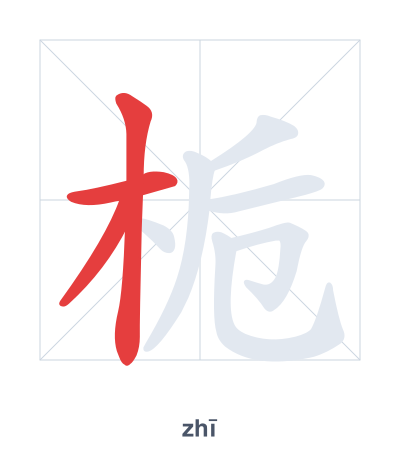
Open Hanzi Writer to see the animated stroke order and practice writing 栀 with real-time feedback.
The character 栀 (zhī) is written with 9 strokes. Follow the standard Chinese stroke order: top to bottom, left to right, outside before inside. The radical 木 is one of its key components.
Practice the correct stroke order with the Hanzi Writer app to see animated stroke-by-stroke guidance with real-time feedback.
栀 means gardenia.
栀 is a phono-semantic compound: the radical 木 (tree) signifies it is a plant, while the component 巵 (zhī) represents an ancient wine vessel, both providing the pronunciation and suggesting the gardenia fruit's flask-like shape.
💡 Memory Tip: Picture a gardenia tree (木) with fruit shaped like an ancient wine vessel (巵), its white blossoms cupped like tiny cups.
栀子花非常香。
zhī zi huā fēi cháng xiāng
Gardenia flowers are very fragrant.
栀子可以做药。
zhī zi kě yǐ zuò yào
Gardenia can be used as medicine.
院子里开了白栀。
yuàn zi lǐ kāi le bái zhī
White gardenias are blooming in the yard.
Open Hanzi Writer to see the animated stroke order and practice writing 栀 with real-time feedback.
✨ Animated stroke order · Handwriting recognition · HSK-graded practice · Free to use
The left side is 木 (wood/tree), indicating that 栀 is a type of plant. The right side is 卮 (zhī), which gives the pronunciation. Together, 木 and 卮 form the character for gardenia, a flowering shrub.