Hanzi Writer

How to Write 斋 (zhāi) — Meaning “Study; Vegetarian diet; Fast”

zhāi 10 strokes Radical: 文

斋 (zhāi) means "Study; Vegetarian diet; Fast" in Chinese. It has 10 strokes with the radical 文.

Rated 4.2/5 in difficulty (advanced).

Appears in 3+ common words including 书斋 (shū zhāi), 斋饭 (zhāi fàn), 开斋节 (kāi zhāi jié).

Due to its 10 strokes, Hanzi Writer's error detection shows 斋 requires focused practice — most learners need 10+ attempts for consistent accuracy.
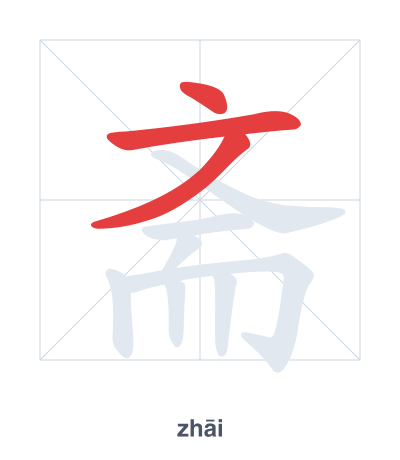
Stroke order practice for 斋 - zhāi

Practice Writing 斋 (zhāi)

Open Hanzi Writer to see the animated stroke order and practice writing 斋 with real-time feedback.

The character (zhāi) is written with 10 strokes. Follow the standard Chinese stroke order: top to bottom, left to right, outside before inside. The radical is one of its key components.

Practice the correct stroke order with the Hanzi Writer app to see animated stroke-by-stroke guidance with real-time feedback.

means Study; Vegetarian diet; Fast.

Character
Pinyinzhāi (zhai)
MeaningStudy; Vegetarian diet; Fast
Strokes10
Radical
Difficulty4.2/5

The character 斋 combines the radical 文 (writing, literature) on top with 而, an ancient pictograph of a beard symbolizing a wise person. Together, they depict a place where a scholar engages in focused study or spiritual disciplines like fasting and vegetarianism.

💡 Memory Tip: Imagine a scholar with a long beard (而) sitting cross-legged reading a book (文) in a quiet study, fasting to purify his mind.

shū zhāi
Study room
zhāi fàn
Vegetarian meal (usually in a temple)
kāi zhāi jié
Eid al-Fitr

他在书斋里看书。

tā zài shū zhāi lǐ kàn shū

He is reading in the study.

寺庙的斋饭很清淡。

sì miào de zhāi fàn hěn qīng dàn

The temple's vegetarian food is very light and plain.

今天是开斋节。

jīn tiān shì kāi zhāi jié

Today is Eid al-Fitr.

Character Pinyin Strokes Radical
(current) zhāi 10
bīn 12
fěi 12
bān 12
Stroke order practice for 斋 - zhāi

Practice Writing 斋 (zhāi)

Open Hanzi Writer to see the animated stroke order and practice writing 斋 with real-time feedback.

✨ Animated stroke order · Handwriting recognition · HSK-graded practice · Free to use

Frequently Asked Questions about 斋

The character 斋 has a top component 文 (literature) and a bottom component that is a simplified form of 齊 (qi, neat). Together, 文 suggests a place for writing or studying, while the neatness element implies a clean, quiet space, leading to meanings like study room or fasting, which requires discipline.

Characters with Radical 文

Other 10-Stroke Characters