瓒 (zàn) means "ritual jade vessel" in Chinese. It has 20 strokes with the radical 王.
Rated 3.8/5 in difficulty (challenging).
Appears in 3+ common words including 玉瓒 (yù zàn), 瓒玉 (zàn yù), 瓒宝 (zàn bǎo).
Due to its 20 strokes, Hanzi Writer's error detection shows 瓒 requires focused practice — most learners need 10+ attempts for consistent accuracy.
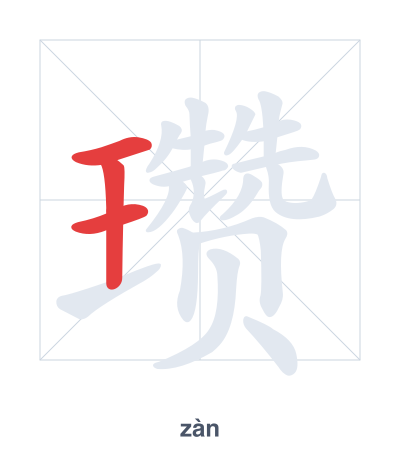
Open Hanzi Writer to see the animated stroke order and practice writing 瓒 with real-time feedback.
The character 瓒 (zàn) is written with 20 strokes. Follow the standard Chinese stroke order: top to bottom, left to right, outside before inside. The radical 王 is one of its key components.
Practice the correct stroke order with the Hanzi Writer app to see animated stroke-by-stroke guidance with real-time feedback.
瓒 means ritual jade vessel.
The character 瓒 combines the radical 王 (jade) with 贊, which provides pronunciation and originally meant 'to assist'—together indicating a jade ritual vessel used in ceremonial assistance. The left side 王 signals the jade material, while the complex right side 贊 visually hints at the vessel's ornate, layered design and its role in supporting rituals.
💡 Memory Tip: Picture a king (王) using a precious jade cup to toast his two guests (先貝), as they assist in an ancient ceremony.
玉瓒是古代的酒器。
yù zàn shì gǔ dài de jiǔ qì
The jade libation ladle is an ancient wine vessel.
他有一块瓒玉。
tā yǒu yī kuài zàn yù
He has a piece of ceremonial jade.
这件瓒宝很贵。
zhè jiàn zàn bǎo hěn guì
This precious treasure is very expensive.
Open Hanzi Writer to see the animated stroke order and practice writing 瓒 with real-time feedback.
✨ Animated stroke order · Handwriting recognition · HSK-graded practice · Free to use
The left part 王 means jade, and the right part 贊 provides the pronunciation zàn. Together, they form a character that refers to a ritual jade vessel used in ancient Chinese ceremonies.