钺 (yuè) means "battle-axe (ancient weapon)" in Chinese. It has 10 strokes with the radical 钅.
Rated 4.2/5 in difficulty (advanced).
Appears in 3+ common words including 斧钺 (fǔ yuè), 钺刀 (yuè dāo), 青铜钺 (qīng tóng yuè).
Due to its 10 strokes, Hanzi Writer's error detection shows 钺 requires focused practice — most learners need 10+ attempts for consistent accuracy.
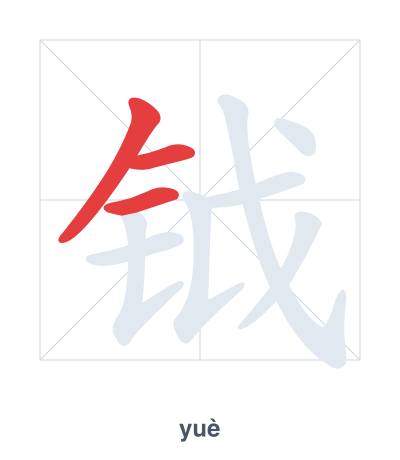
Open Hanzi Writer to see the animated stroke order and practice writing 钺 with real-time feedback.
The character 钺 (yuè) is written with 10 strokes. Follow the standard Chinese stroke order: top to bottom, left to right, outside before inside. The radical 钅 is one of its key components.
Practice the correct stroke order with the Hanzi Writer app to see animated stroke-by-stroke guidance with real-time feedback.
钺 means battle-axe (ancient weapon).
The character 钺 is a compound of the metal radical 钅 and 戉, which itself was a pictograph of a large axe blade mounted on a handle. Together, they form the meaning 'battle-axe', a weapon made of metal used in ancient Chinese warfare.
💡 Memory Tip: Picture a gleaming metal axe (钅) with a menacing curved blade (like the upper part of 戉) chopping through a battlefield.
古代士兵使用斧钺。
gǔ dài shì bīng shǐ yòng fǔ yuè
Ancient soldiers used battle-axes.
这把钺刀非常锋利。
zhè bǎ yuè dāo fēi cháng fēng lì
This battle-axe is very sharp.
博物馆里有青铜钺。
bó wù guǎn lǐ yǒu qīng tóng yuè
There are bronze battle-axes (yue) in the museum.
Open Hanzi Writer to see the animated stroke order and practice writing 钺 with real-time feedback.
✨ Animated stroke order · Handwriting recognition · HSK-graded practice · Free to use
The left side is the radical 钅, meaning metal or gold, indicating the weapon is made of metal. The right side is 戉, which was an ancient pictograph of a battle-axe. Together, they form a character meaning a battle-axe used in ancient warfare.