莸 (yóu) means "Caryopteris (bluebeard)" in Chinese. It has 10 strokes with the radical 艹.
Rated 4.2/5 in difficulty (advanced).
Appears in 3+ common words including 莸草 (yóu cǎo), 兰莸 (lán yóu), 莸属 (yóu shǔ).
Due to its 10 strokes, Hanzi Writer's error detection shows 莸 requires focused practice — most learners need 10+ attempts for consistent accuracy.
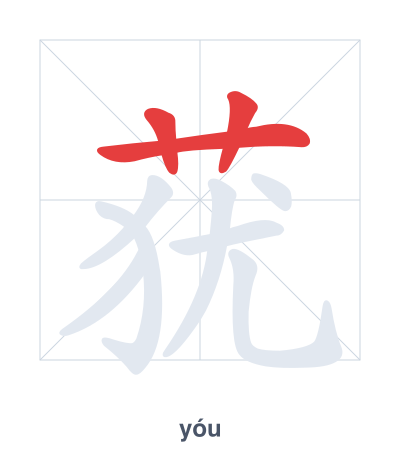
Open Hanzi Writer to see the animated stroke order and practice writing 莸 with real-time feedback.
The character 莸 (yóu) is written with 10 strokes. Follow the standard Chinese stroke order: top to bottom, left to right, outside before inside. The radical 艹 is one of its key components.
Practice the correct stroke order with the Hanzi Writer app to see animated stroke-by-stroke guidance with real-time feedback.
莸 means Caryopteris (bluebeard).
莸 is a phono-semantic compound. The radical 艹 (grass) indicates it is a plant, while 尤 (yóu) provides the pronunciation. The character refers to Caryopteris, a type of bluebeard shrub.
💡 Memory Tip: Picture a patch of grass (艹) where a strange bluebeard plant grows, looking extra special (尤) with its blue flowers.
这种植物叫莸草。
zhè zhòng zhí wù jiào yóu cǎo
This plant is called bluebeard.
兰莸散发着清香。
lán yóu sàn fà zhe qīng xiāng
The fragrant plants emit a fresh scent.
莸属植物很多见。
yóu shǔ zhí wù hěn duō jiàn
Plants of the genus Caryopteris are very common.
Open Hanzi Writer to see the animated stroke order and practice writing 莸 with real-time feedback.
✨ Animated stroke order · Handwriting recognition · HSK-graded practice · Free to use
莸 is made of two parts: the top radical 艹 (grass) and the bottom part 尤 (yóu). The grass radical shows that 莸 is a type of plant, while 尤 gives the pronunciation and does not relate to the plant's meaning.