茔 (yíng) means "grave" in Chinese. It has 8 strokes with the radical 艹.
Rated 3.7/5 in difficulty (challenging).
Appears in 3+ common words including 坟茔 (fén yíng), 茔地 (yíng dì), 祖茔 (zǔ yíng).
Due to its 8 strokes, Hanzi Writer's error detection shows 茔 requires focused practice — most learners need 10+ attempts for consistent accuracy.
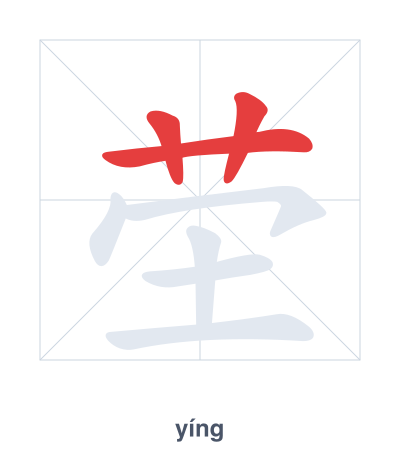
Open Hanzi Writer to see the animated stroke order and practice writing 茔 with real-time feedback.
The character 茔 (yíng) is written with 8 strokes. Follow the standard Chinese stroke order: top to bottom, left to right, outside before inside. The radical 艹 is one of its key components.
Practice the correct stroke order with the Hanzi Writer app to see animated stroke-by-stroke guidance with real-time feedback.
茔 means grave.
This character combines grass (艹) above earth (土), depicting a grave as an earthen mound covered with vegetation. It is a simplified form of 塋, which originally included a cover element (冖) over the earth, but the core idea remains: a burial site marked by soil and grass.
💡 Memory Tip: Picture grass (艹) sprouting from a mound of earth (土) — that's where the body rests in its grave.
他在坟茔前。
tā zài fén yíng qián
He is in front of the grave.
这里是茔地。
zhè lǐ shì yíng dì
This is a graveyard.
祖茔在山坡上。
zǔ yíng zài shān pō shàng
The ancestral graveyard is on the hillside.
Open Hanzi Writer to see the animated stroke order and practice writing 茔 with real-time feedback.
✨ Animated stroke order · Handwriting recognition · HSK-graded practice · Free to use
The character 茔 is composed of three parts: grass (艹) on top, a cover (冖) in the middle, and earth (土) at the bottom. Together, they suggest a grave — a grassy mound covering a tomb in the ground. This matches the meaning of 'grave' or 'burial ground'.