氤 (yīn) means "Mist or vapor" in Chinese. It has 10 strokes with the radical 气.
Rated 4.2/5 in difficulty (advanced).
Appears in 3+ common words including 氤氲 (yīn yūn), 氤氲不散 (yīn yūn bù sàn), 水汽氤氲 (shuǐ qì yīn yūn).
Due to its 10 strokes, Hanzi Writer's error detection shows 氤 requires focused practice — most learners need 10+ attempts for consistent accuracy.
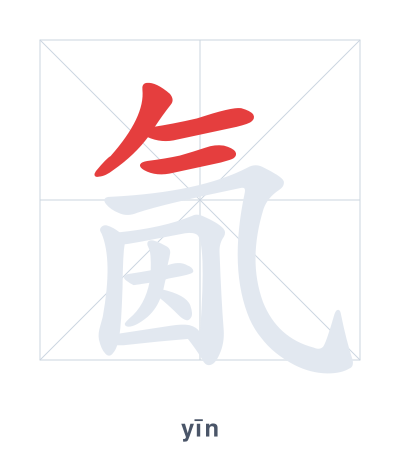
Open Hanzi Writer to see the animated stroke order and practice writing 氤 with real-time feedback.
The character 氤 (yīn) is written with 10 strokes. Follow the standard Chinese stroke order: top to bottom, left to right, outside before inside. The radical 气 is one of its key components.
Practice the correct stroke order with the Hanzi Writer app to see animated stroke-by-stroke guidance with real-time feedback.
氤 means Mist or vapor.
| Character | 氤 |
| Pinyin | yīn (yin) |
| Meaning | Mist or vapor |
| Strokes | 10 |
| Radical | 气 |
| Difficulty | 4.2/5 |
氤 is a compound character with the radical 气 (air/steam) on the left, indicating mist or vapor, and the phonetic component 因 (yīn) on the right, which also hints at 'cause' or 'origin'—the mist arises from some source.
💡 Memory Tip: Picture steam (气) rising from a 'yin' (因) organ—the mist is caused by a hidden, mysterious origin.
山间云雾氤氲。
shān jiān yún wù yīn yūn
The mountains are shrouded in dense mist and clouds.
烟雾在屋里氤氲不散。
yān wù zài wū lǐ yīn yūn bù sàn
The smoke lingers in the room.
温泉水汽氤氲。
wēn quán shuǐ qì yīn yūn
The hot spring is shrouded in mist.
Open Hanzi Writer to see the animated stroke order and practice writing 氤 with real-time feedback.
✨ Animated stroke order · Handwriting recognition · HSK-graded practice · Free to use
氤 consists of the radical 气 (qì, meaning air or vapor) on the left, and 因 (yīn) on the right, which gives the character its pronunciation. The 气 radical directly connects the character to the concept of mist or vapor, while 因 serves as a phonetic component.