氚 (chuān) means "tritium" in Chinese. It has 7 strokes with the radical 气.
Rated 3.5/5 in difficulty (challenging).
Appears in 3+ common words including 氚气 (chuān qì), 氚水 (chuān shuǐ), 氚核 (chuān hé).
Due to its 7 strokes, Hanzi Writer's error detection shows 氚 requires focused practice — most learners need 10+ attempts for consistent accuracy.
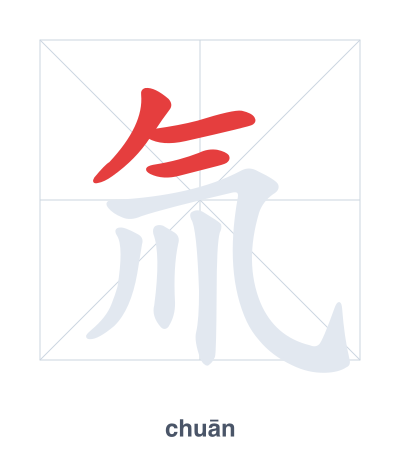
Open Hanzi Writer to see the animated stroke order and practice writing 氚 with real-time feedback.
The character 氚 (chuān) is written with 7 strokes. Follow the standard Chinese stroke order: top to bottom, left to right, outside before inside. The radical 气 is one of its key components.
Practice the correct stroke order with the Hanzi Writer app to see animated stroke-by-stroke guidance with real-time feedback.
氚 means tritium.
| Character | 氚 |
| Pinyin | chuān (chuan) |
| Meaning | tritium |
| Strokes | 7 |
| Radical | 气 |
| Difficulty | 3.5/5 |
氚 is a compound character combining the radical 气 (gas/air) on the left, indicating it is a gaseous element, with 川 (chuān, river/stream) on the right serving as a phonetic component to suggest the pronunciation. This character was created in modern times to represent the radioactive hydrogen isotope tritium (³H), following the pattern of other hydrogen isotope characters like 氕 (protium) and 氘 (deuterium).
💡 Memory Tip: Picture the three strokes of 川 as the three subatomic particles in tritium's nucleus—one proton and two neutrons—floating inside the gas container 气.
实验室里有氚气。
shí yàn shì lǐ yǒu chuān qì
There is tritium gas in the laboratory.
这种水里含有氚。
zhè zhǒng shuǐ lǐ hán yǒu chuān
This water contains tritium.
氚核是氢的同位素。
chuān hé shì qīng de tóng wèi sù
Tritium is an isotope of hydrogen.
Open Hanzi Writer to see the animated stroke order and practice writing 氚 with real-time feedback.
✨ Animated stroke order · Handwriting recognition · HSK-graded practice · Free to use
氚 consists of the radical 气 (qì, meaning gas) on the left and the component 川 (chuān, meaning river or stream) on the right. 气 tells you it is a type of gas, and 川 provides the pronunciation chuān while also suggesting a flowing or streaming quality, which matches the idea of a gas or isotope.