泆 (yì) means "To overflow; excessive" in Chinese. It has 8 strokes with the radical 氵.
Rated 3.7/5 in difficulty (challenging).
Appears in 3+ common words including 淫泆 (yín yì), 泆荡 (yì dàng), 溢泆 (yì yì).
Due to its 8 strokes, Hanzi Writer's error detection shows 泆 requires focused practice — most learners need 10+ attempts for consistent accuracy.
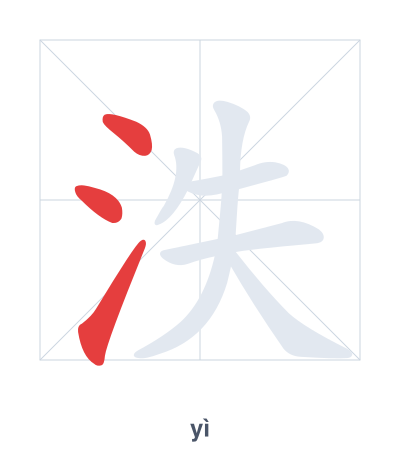
Open Hanzi Writer to see the animated stroke order and practice writing 泆 with real-time feedback.
The character 泆 (yì) is written with 8 strokes. Follow the standard Chinese stroke order: top to bottom, left to right, outside before inside. The radical 氵 is one of its key components.
Practice the correct stroke order with the Hanzi Writer app to see animated stroke-by-stroke guidance with real-time feedback.
泆 means To overflow; excessive.
泆 combines the water radical (氵) with the phonetic component 失 (shī, 'to lose'), suggesting water that has lost its proper boundaries—hence overflowing or becoming excessive.
💡 Memory Tip: Picture a river losing (失) its banks as water (氵) gushes out in a wild, excessive flood.
生活不能太淫泆。
shēng huó bù néng tài yín yì
Life should not be too licentious or excessive.
他的行为很泆荡。
tā de xíng wéi hěn yì dàng
His behavior is dissolute.
水流溢泆出来了。
shuǐ liú yì yì chū lái le
The water has overflowed.
Open Hanzi Writer to see the animated stroke order and practice writing 泆 with real-time feedback.
✨ Animated stroke order · Handwriting recognition · HSK-graded practice · Free to use
The left side 氵 is the water radical, indicating the character relates to water or flow. The right side 失 means "to lose" or "to slip," suggesting water that loses its proper boundaries. Together, they create the idea of water overflowing or excess.