殹 (yì) means "An archaic particle used in ancient Chinese texts." in Chinese. It has 11 strokes with the radical 殳.
Rated 4.2/5 in difficulty (advanced).
Appears in 3+ common words including 殹然 (yì rán), 呜殹 (wū yì), 殹殹 (yì yì).
Due to its 11 strokes, Hanzi Writer's error detection shows 殹 requires focused practice — most learners need 10+ attempts for consistent accuracy.
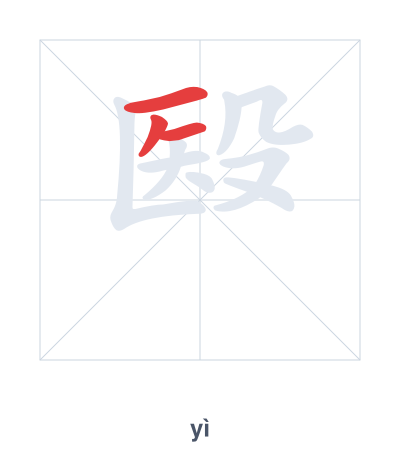
Open Hanzi Writer to see the animated stroke order and practice writing 殹 with real-time feedback.
The character 殹 (yì) is written with 11 strokes. Follow the standard Chinese stroke order: top to bottom, left to right, outside before inside. The radical 殳 is one of its key components.
Practice the correct stroke order with the Hanzi Writer app to see animated stroke-by-stroke guidance with real-time feedback.
殹 means An archaic particle used in ancient Chinese texts..
| Character | 殹 |
| Pinyin | yì (yi) |
| Meaning | An archaic particle used in ancient Chinese texts. |
| Strokes | 11 |
| Radical | 殳 |
| Difficulty | 4.2/5 |
The character 殹 combines 医 (an arrow in a quiver) and 殳 (a hand holding a weapon). This originally depicted the action of striking an arrow, but the graph was later borrowed phonetically as a grammatical particle in classical Chinese, similar to 也.
💡 Memory Tip: Picture a warrior striking a quiver of arrows with a weapon, producing a sharp 'yì' sound that ends an ancient sentence.
他殹然长叹一声。
tā yì rán cháng tàn yī shēng
He let out a deep sigh.
风中发出呜殹的声音。
fēng zhōng fā chū wū yì de shēng yīn
A moaning sound came from the wind.
林间传来殹殹之声。
lín jiān chuán lái yì yì zhī shēng
A low rustling sound came from the forest.
Open Hanzi Writer to see the animated stroke order and practice writing 殹 with real-time feedback.
✨ Animated stroke order · Handwriting recognition · HSK-graded practice · Free to use
殹 is composed of 医 (yī) on the left and 殳 (shū) on the right. The right radical 殳 originally depicts a hand holding a weapon, but here the character functions as a phonetic compound for an archaic particle, so its meaning is not directly tied to the components.