砑 (yà) means "to calender; to polish with a heavy stone" in Chinese. It has 9 strokes with the radical 石.
Rated 4/5 in difficulty (challenging).
Appears in 3+ common words including 砑光 (yà guāng), 砑花 (yà huā), 砑石 (yà shí).
Due to its 9 strokes, Hanzi Writer's error detection shows 砑 requires focused practice — most learners need 10+ attempts for consistent accuracy.
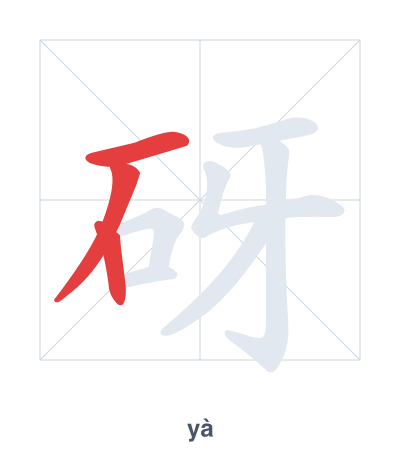
Open Hanzi Writer to see the animated stroke order and practice writing 砑 with real-time feedback.
The character 砑 (yà) is written with 9 strokes. Follow the standard Chinese stroke order: top to bottom, left to right, outside before inside. The radical 石 is one of its key components.
Practice the correct stroke order with the Hanzi Writer app to see animated stroke-by-stroke guidance with real-time feedback.
砑 means to calender; to polish with a heavy stone.
砑 is a phono-semantic compound with radical 石 (stone) indicating the material tool, and phonetic component 牙 (tooth, yá) not only indicating pronunciation but also evoking the pressing or grinding action of teeth, as a heavy stone is used to smooth surfaces.
💡 Memory Tip: Imagine a heavy stone (石) with jagged teeth (牙) rolling across fabric, pressing it flat and shiny like a calender.
纸张经过了砑光处理。
zhǐ zhāng jīng guò le yà guāng chǔ lǐ
The paper has been calendered (glazed).
这种布上有砑花。
zhè zhǒng bù shàng yǒu yà huā
This cloth has calendered patterns.
他用砑石磨纸。
tā yòng yà shí mò zhǐ
He used a polishing stone to smooth the paper.
Open Hanzi Writer to see the animated stroke order and practice writing 砑 with real-time feedback.
✨ Animated stroke order · Handwriting recognition · HSK-graded practice · Free to use
砑 is made of two parts: the left radical 石 (stone) and the right component 牙 (tooth). The stone radical shows that the character relates to a stone tool, while 牙 provides the pronunciation yà. Together, they represent using a heavy stone to polish or press something smooth.